The Ancient East at the Istanbul Archaeology Museums
A walk on 1 November 2026 · from Konstantin's photos, in the order we went round
The museum courtyard
The main building opened in 1891. Its architect, Alexandre Vallaury, borrowed the façade from the Sarcophagus of the Mourning Women inside. The garden is an open-air display of Roman and Byzantine columns, capitals and tombstones.
3rd–2nd millennium BC · Mesopotamia
Sumer, Akkad and Old Babylon. These pieces left Iraq in the late 19th and early 20th centuries, when it was part of the Ottoman Empire.
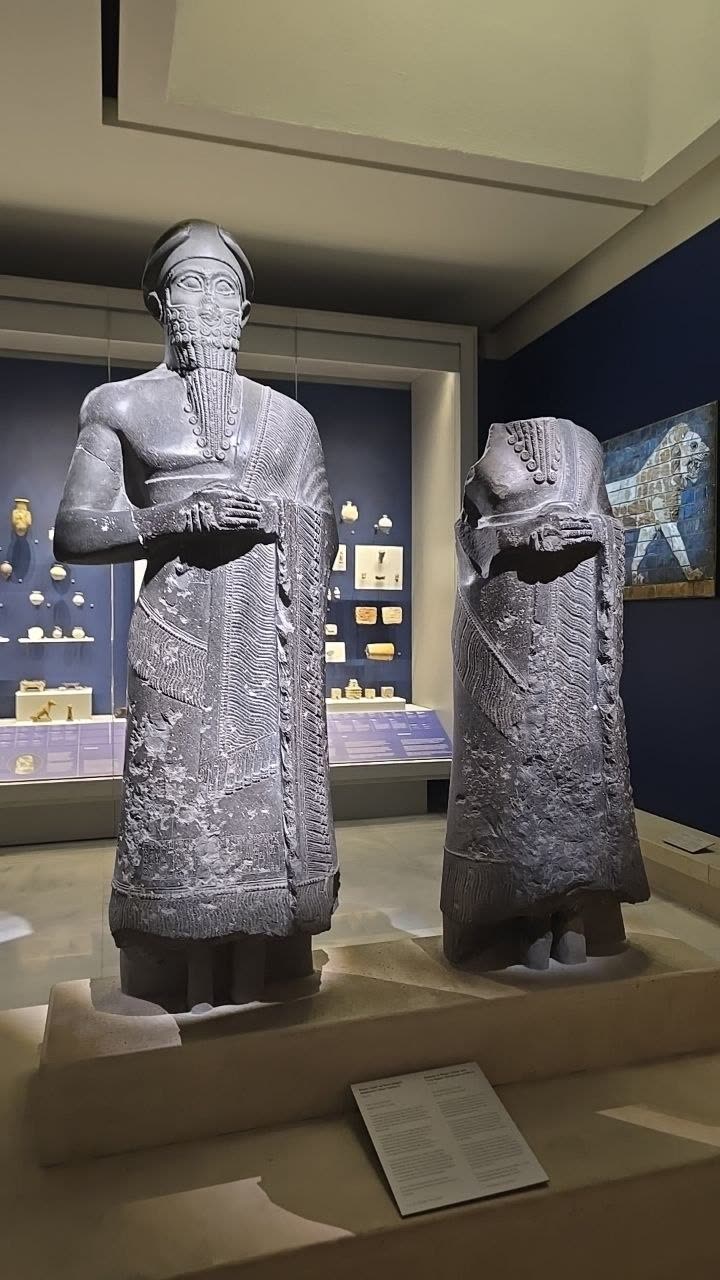
Puzur-Ishtar and Tura-Dagan, governors of Mari
Father (the headless one) and son ruled Mari on the Euphrates with the title shakkanakku, military governor. This was after the Akkadian empire broke up, at the same time as the Third Dynasty of Ur. The statues stood in the temple wing of the palace at Mari, but they were found at Babylon, in the palace of Nebuchadnezzar II, probably carried off as war booty. The head of Puzur-Ishtar is in Berlin; this one is a cast. The lion on the wall behind them comes from the Processional Way to the Ishtar Gate, 6th century BC.
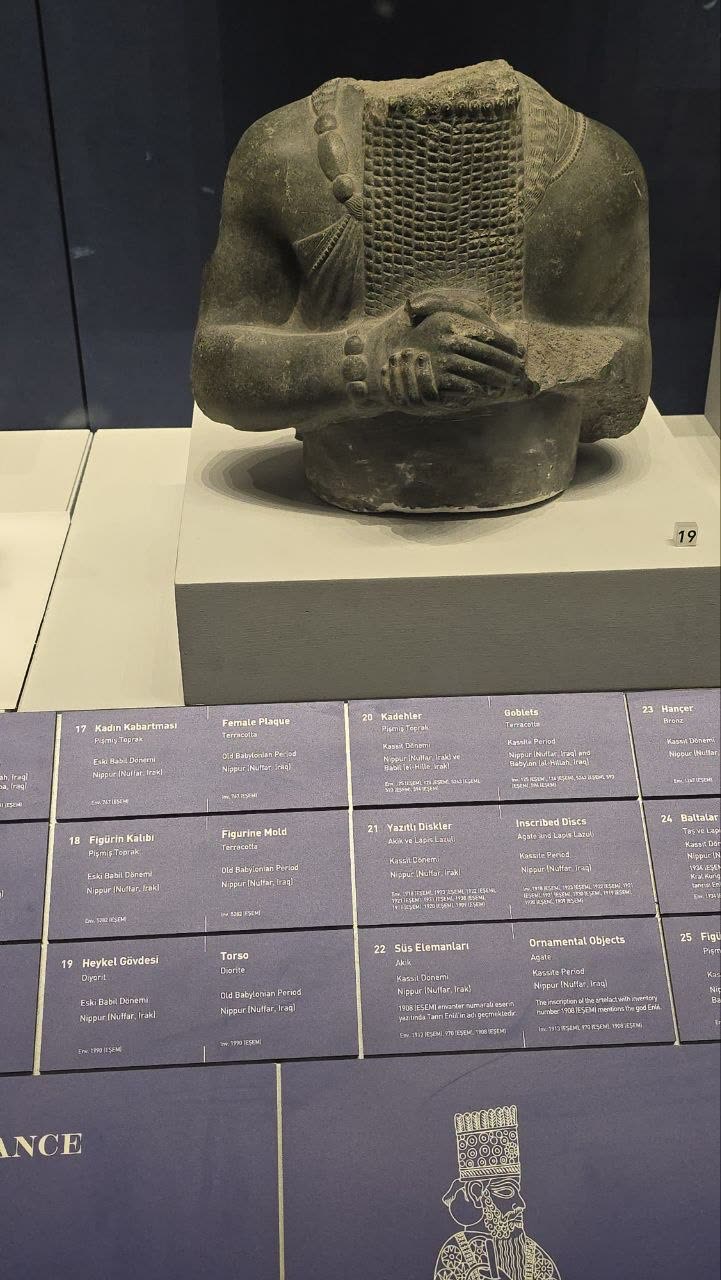
Torso of a statue (no. 19)
The pose is the same as Puzur-Ishtar's: hands clasped at the chest, a gesture of prayer. A statue like this was set up in a temple so that it would keep praying for its owner. Nippur was the religious capital of Sumer, the city of the god Enlil.
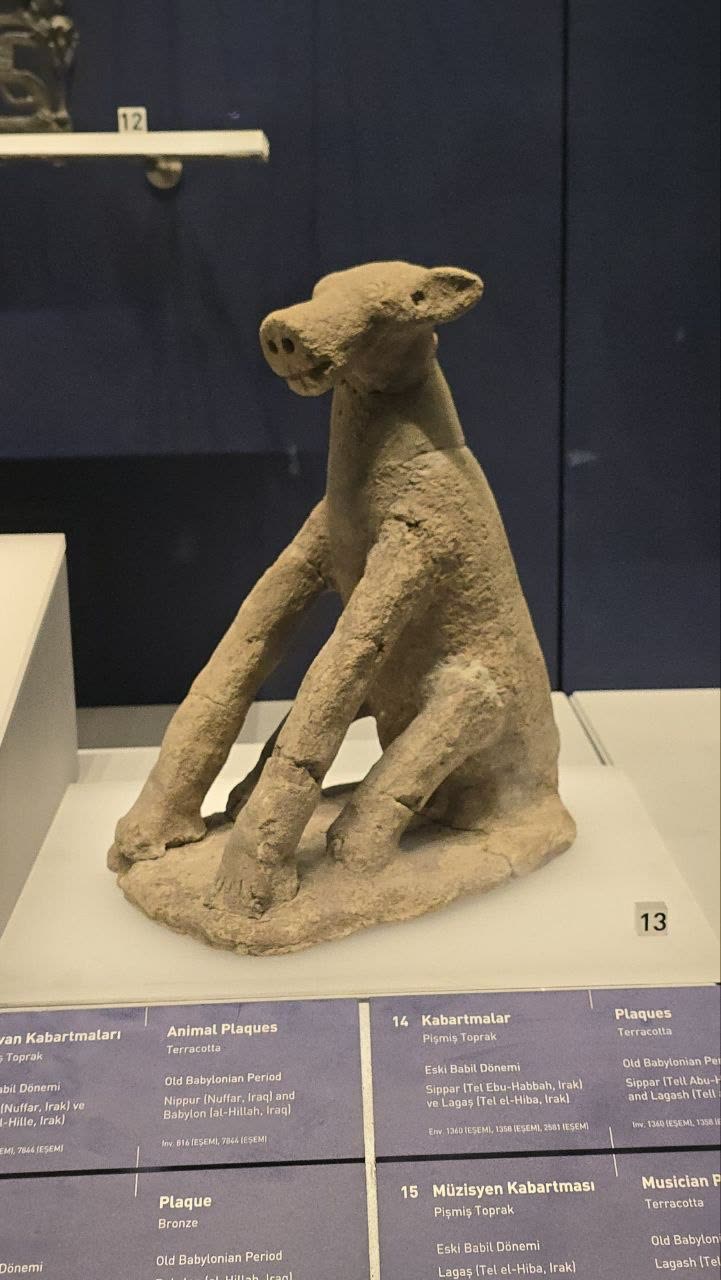
Dog from Sippar
Sippar was the city of the sun god Shamash. The dog was the sacred animal of Gula, goddess of healing. People brought dogs like this to the temple to give thanks for a cure or to ask for one.
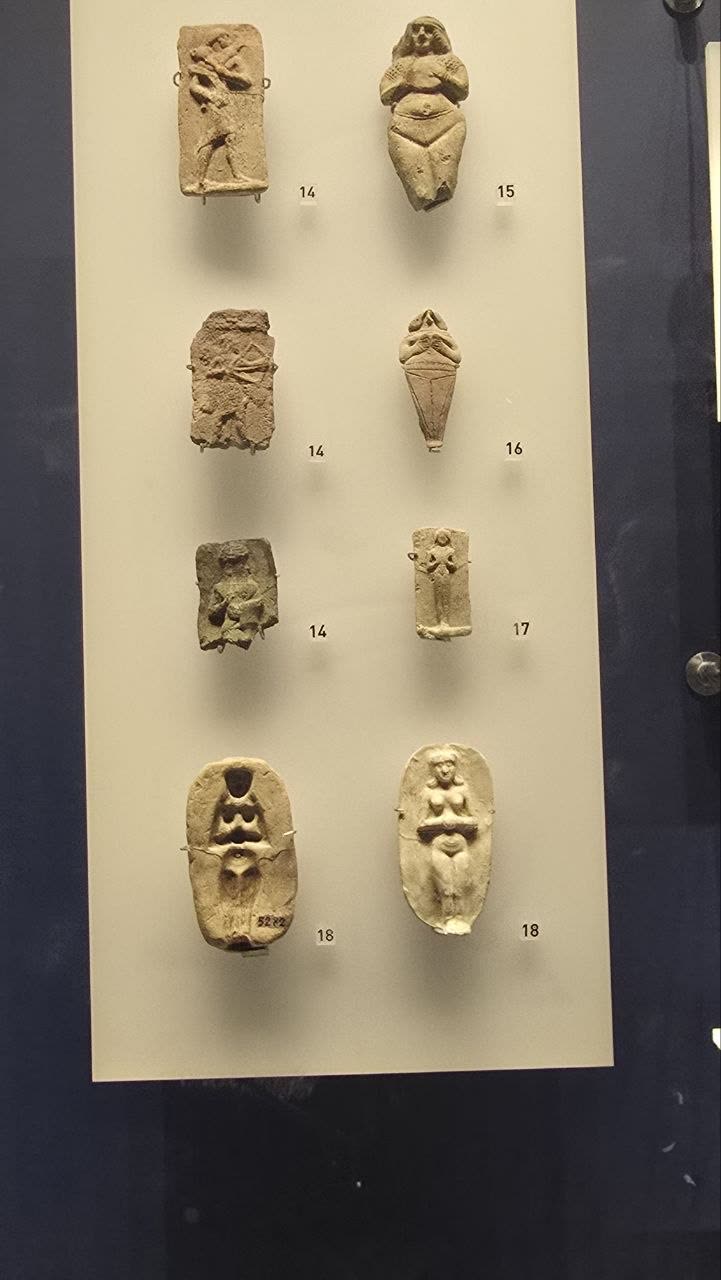
Plaques and a figurine mould (nos. 14–18)
Cheap, mass-produced images: hunters, musicians, female figures. No. 18 is a mould (left) with a cast taken from it (right). Wet clay was pressed into the mould to stamp out identical figurines. The naked woman holding her breasts is a fertility image. People kept figurines like these at home as charms.
11th–8th centuries BC · the Neo-Hittite kingdoms
When the Hittite empire fell around 1180 BC, small kingdoms in south-eastern Anatolia and Syria carried on its art. Sam'al was the capital of one of them, near present-day Gaziantep, in the 9th and 8th centuries BC. Its kings were Aramaean, but their art was Neo-Hittite: stone slabs carved in relief, called orthostats, lined the lower walls at the gates and palaces. A German expedition excavated the city in 1888–1902, and the finds were divided between Berlin and Istanbul. Nearly all the slabs below are basalt, 9th century BC, from the South Gate of the city and the citadel.
Stele of Tara, ruler of Melid
The inscription, in Anatolian hieroglyphs, says that Tara, ruler of Melid (Malatya), founded the city of Taita and pushed out the borders of his kingdom. It is one of the earliest inscriptions from the Neo-Hittite kingdoms after the fall of the Hittite empire.
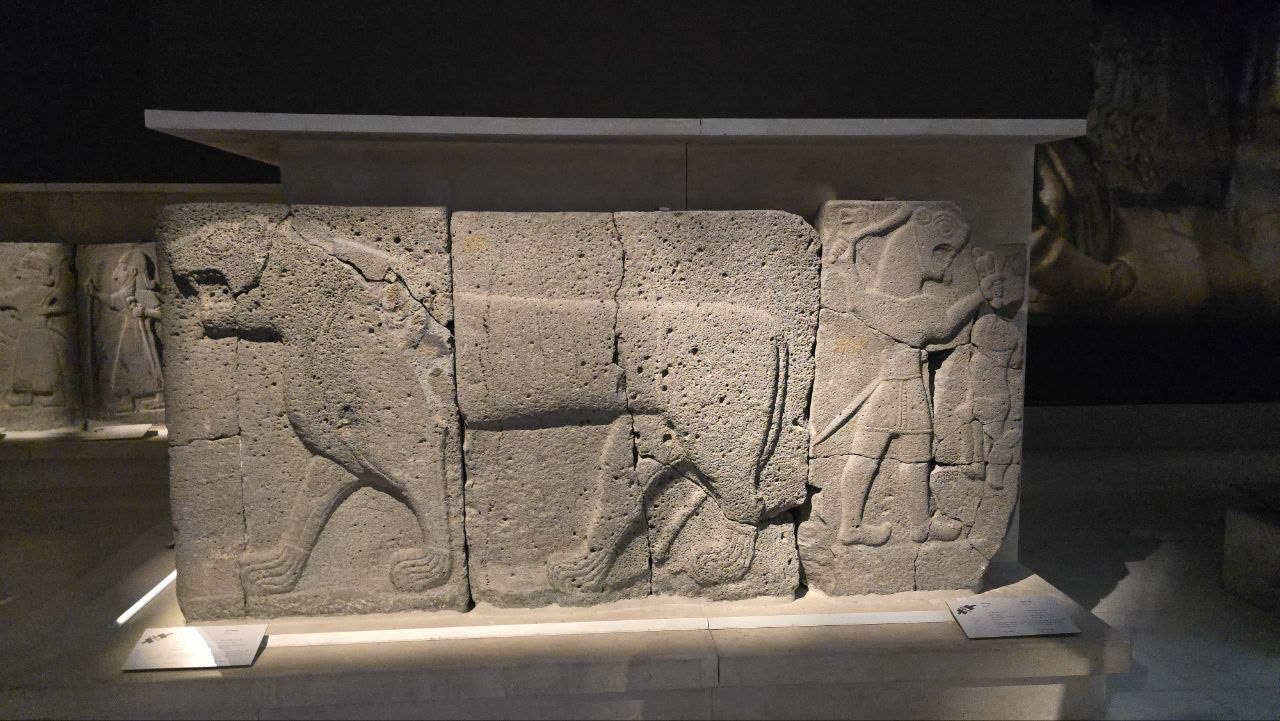
How it looked
The slabs are set in a row, as they stood at the gate. Anyone coming in walked past guardian monsters, hunters and warriors: the wall showed off the king's power and kept evil spirits away.
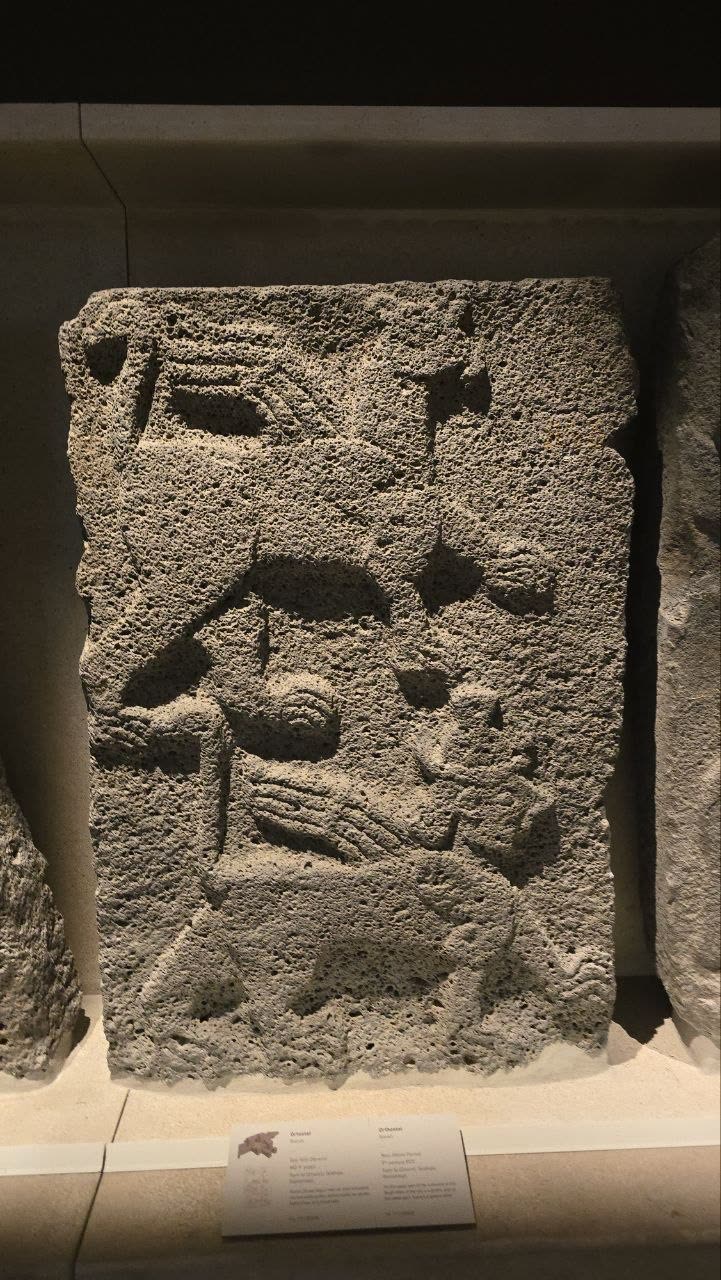
Griffin and sphinx
A griffin above, a sphinx below. Both guard the passage; they were put at gates as protection against evil forces.
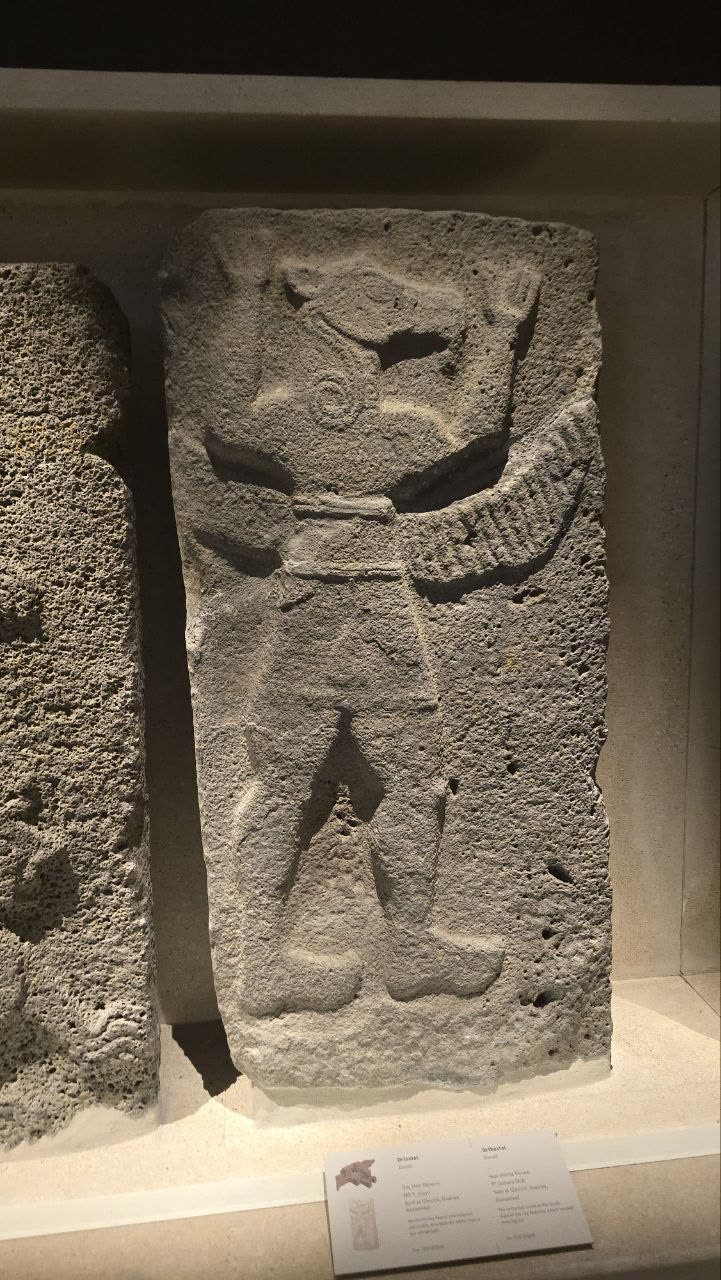
Winged guardian spirit
A human figure with wings, a semi-divine protector. The Assyrians carved similar "genies", but this one is rougher and plainer, the work of a local workshop.
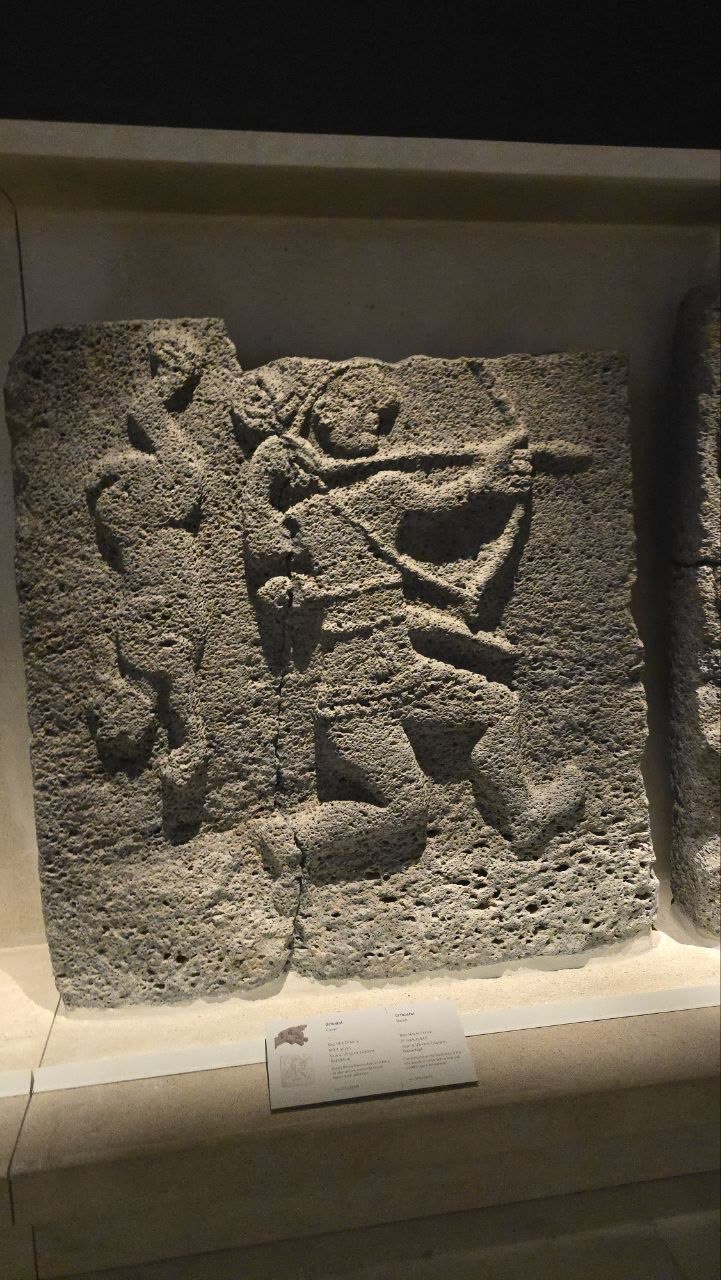
The hunt
A hunter draws his bow. Hunting was a royal pursuit: it showed that the ruler kept the wild world in check.
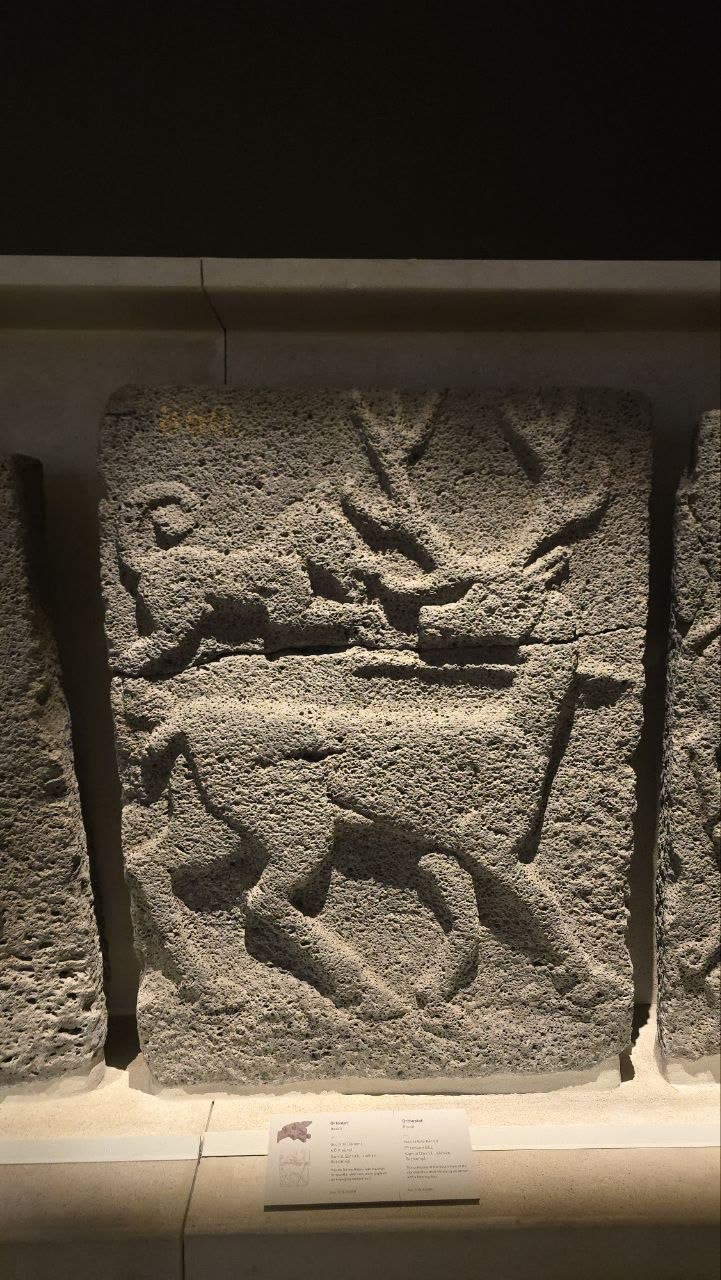
Stag shot with an arrow, and a hunting dog
We don't see the archer, only the result: a wounded stag and a dog chasing it.
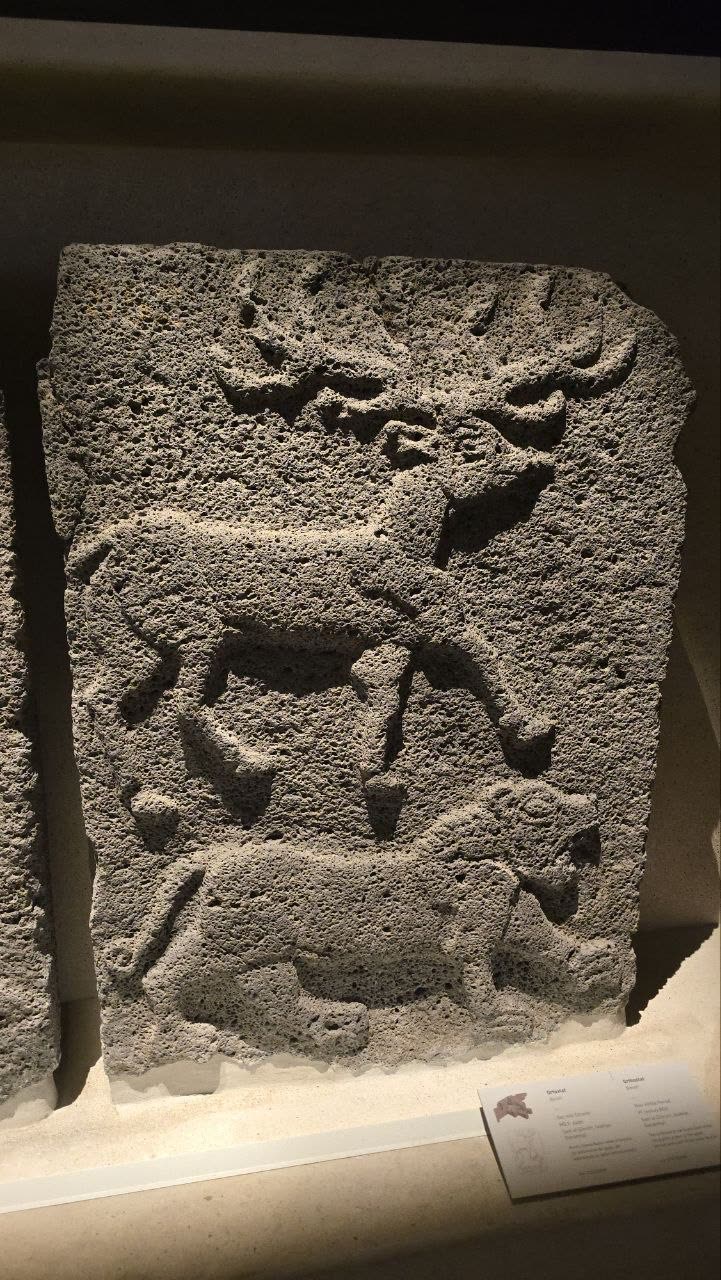
Stag above, lion below
Two registers: a peaceful animal and a predator. The carvers liked to fill a slab with two scenes, one above the other.
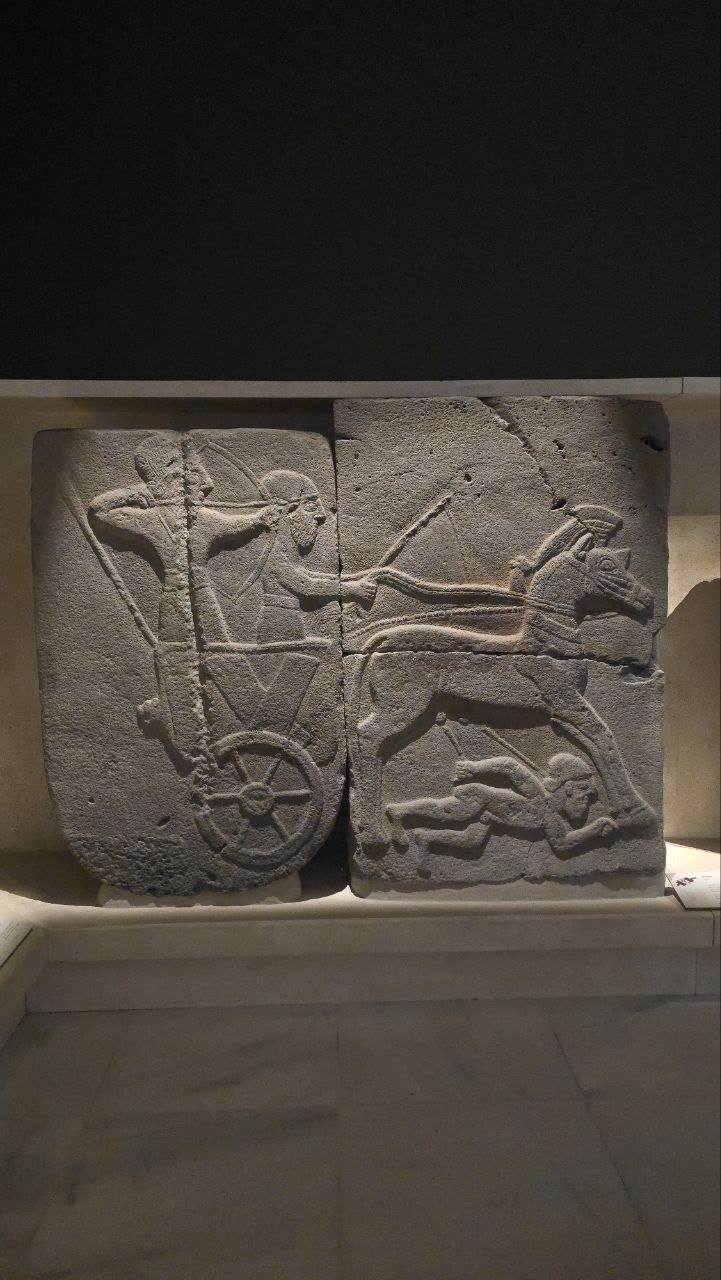
War chariot
A driver and an archer in the chariot, with a fallen enemy under the horse's hooves. The chariot was the main strike force of armies at the time.
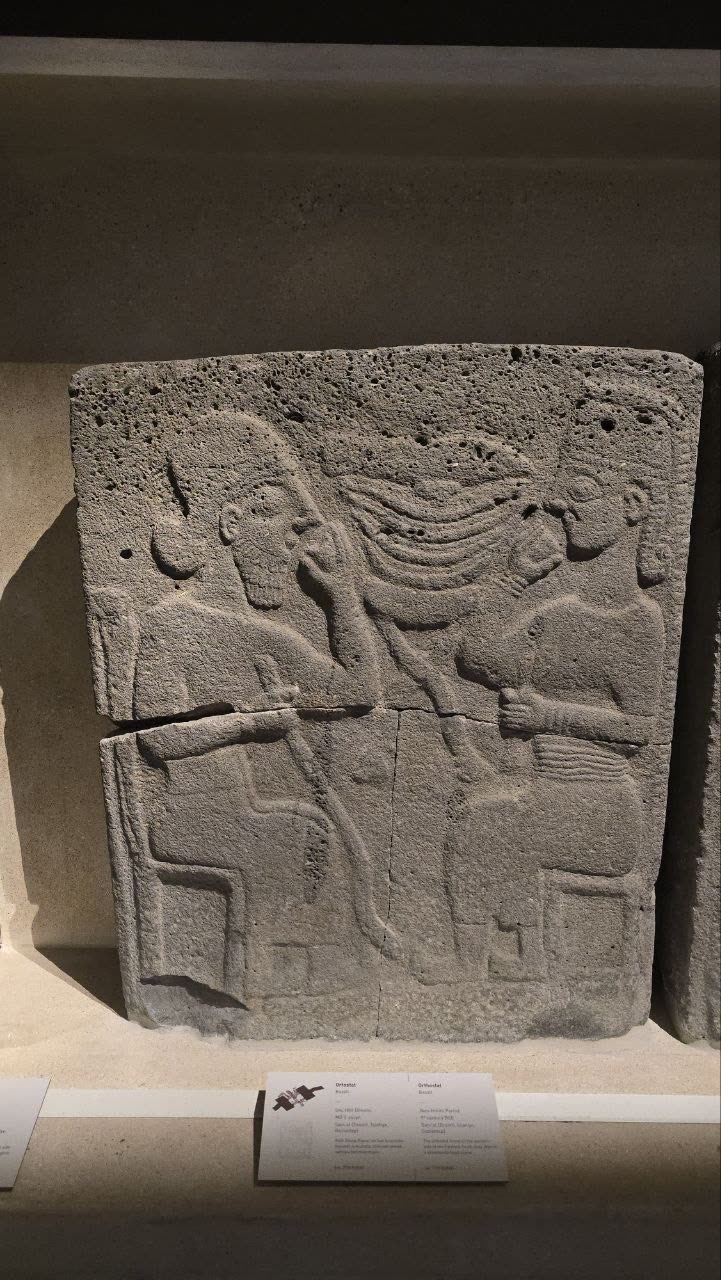
Ritual banquet
A seated figure at a table and a servant with a fan. A banquet scene often stood for a funerary meal or a royal feast.
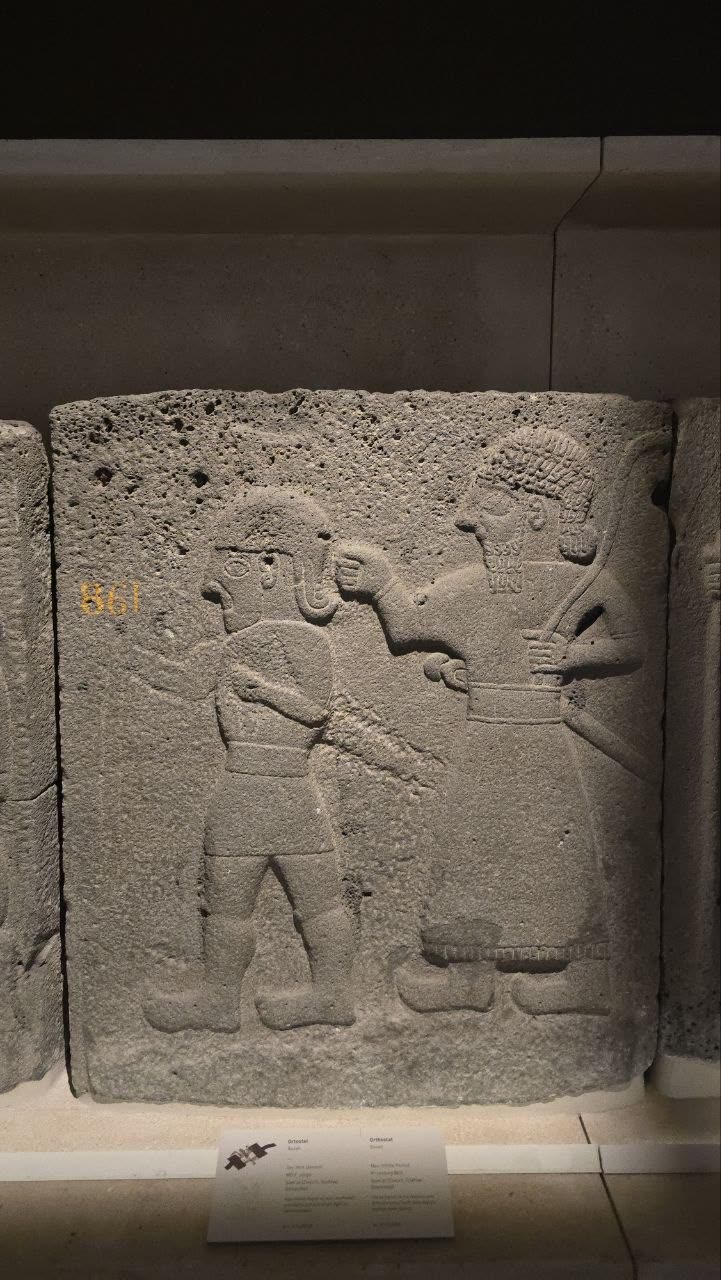
Men walking
Members of a procession: a march to the gate or to the king was a common subject on these walls.
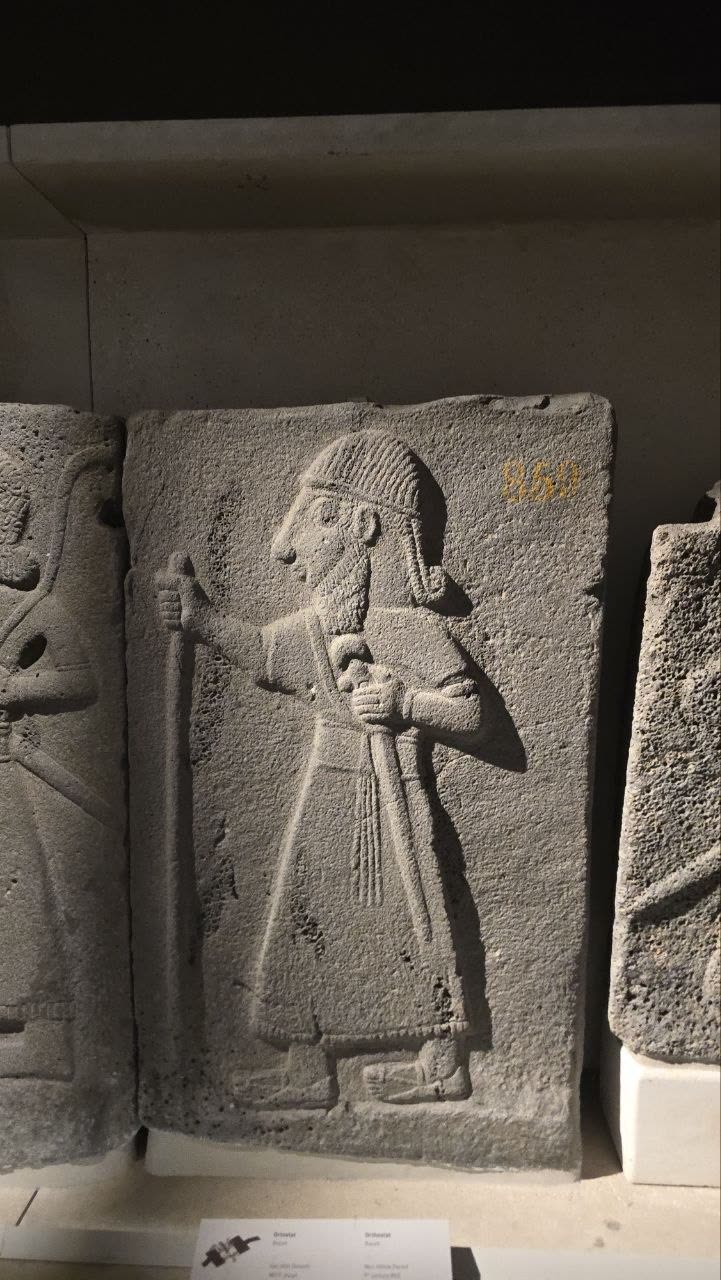
Man with a sword and staff
Sword in the left hand, staff in the right. The long robe and beard mark a nobleman or court official.
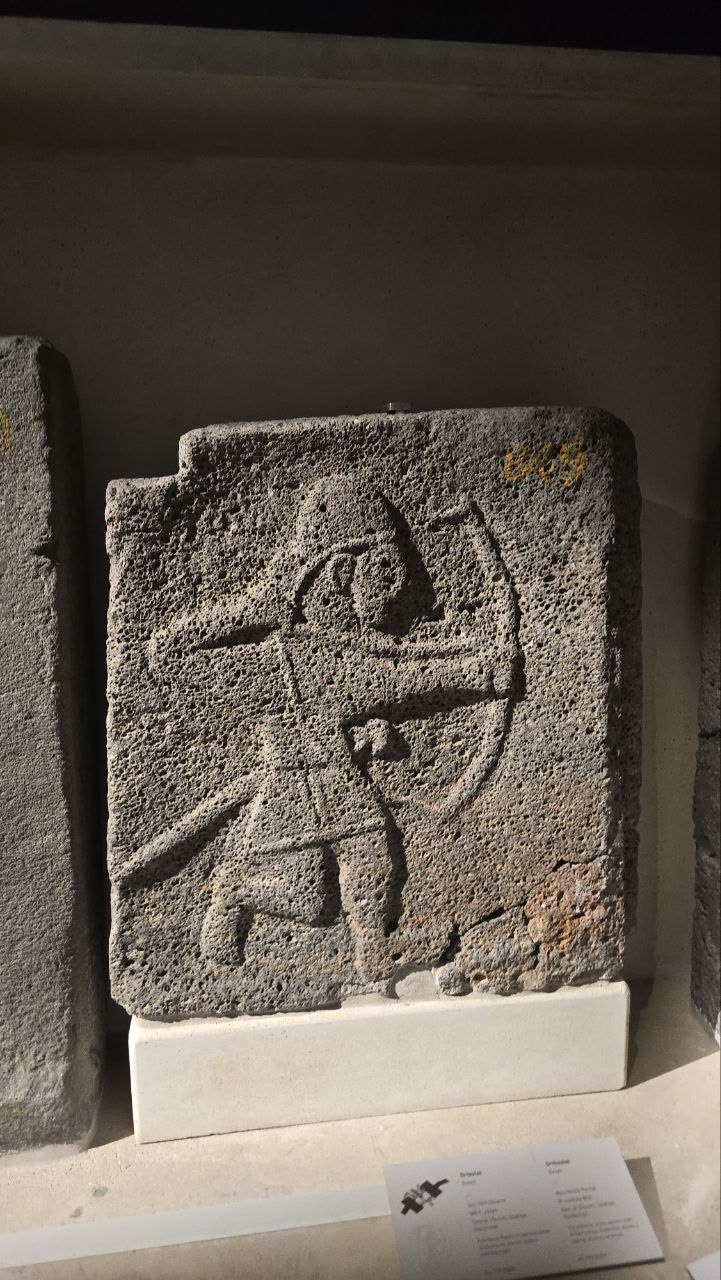
Warrior shooting a bow
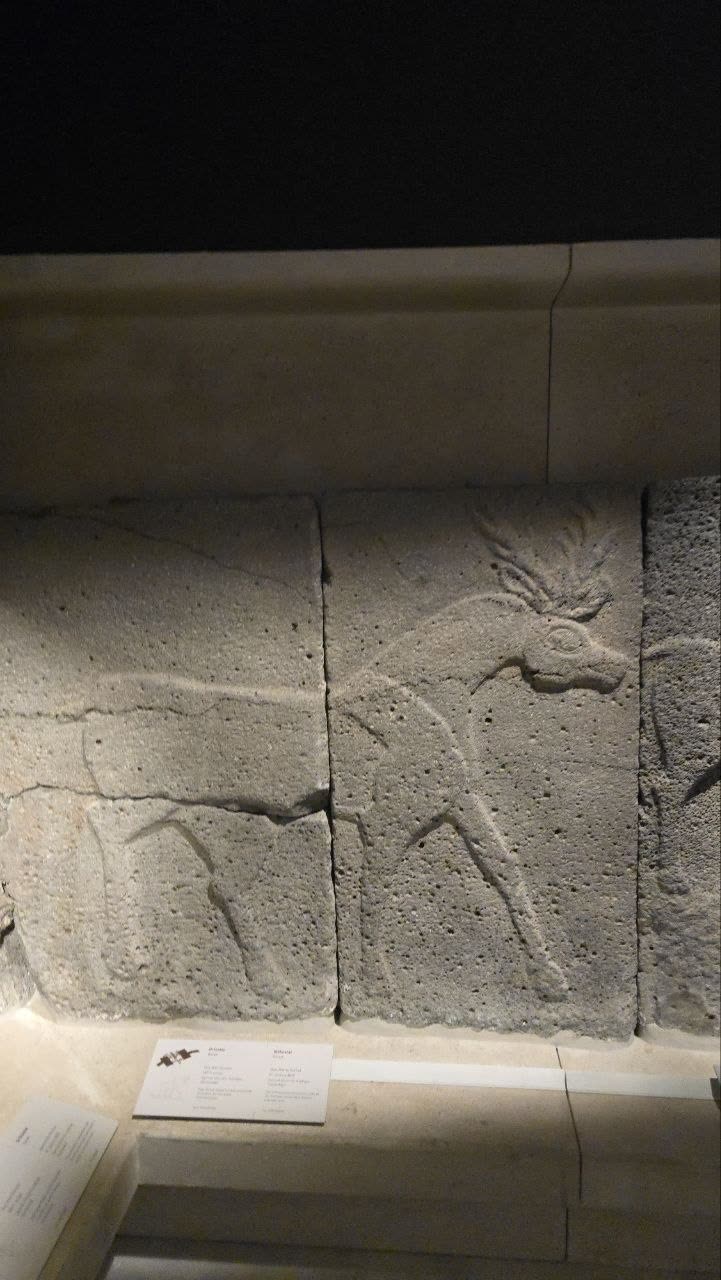
Stag
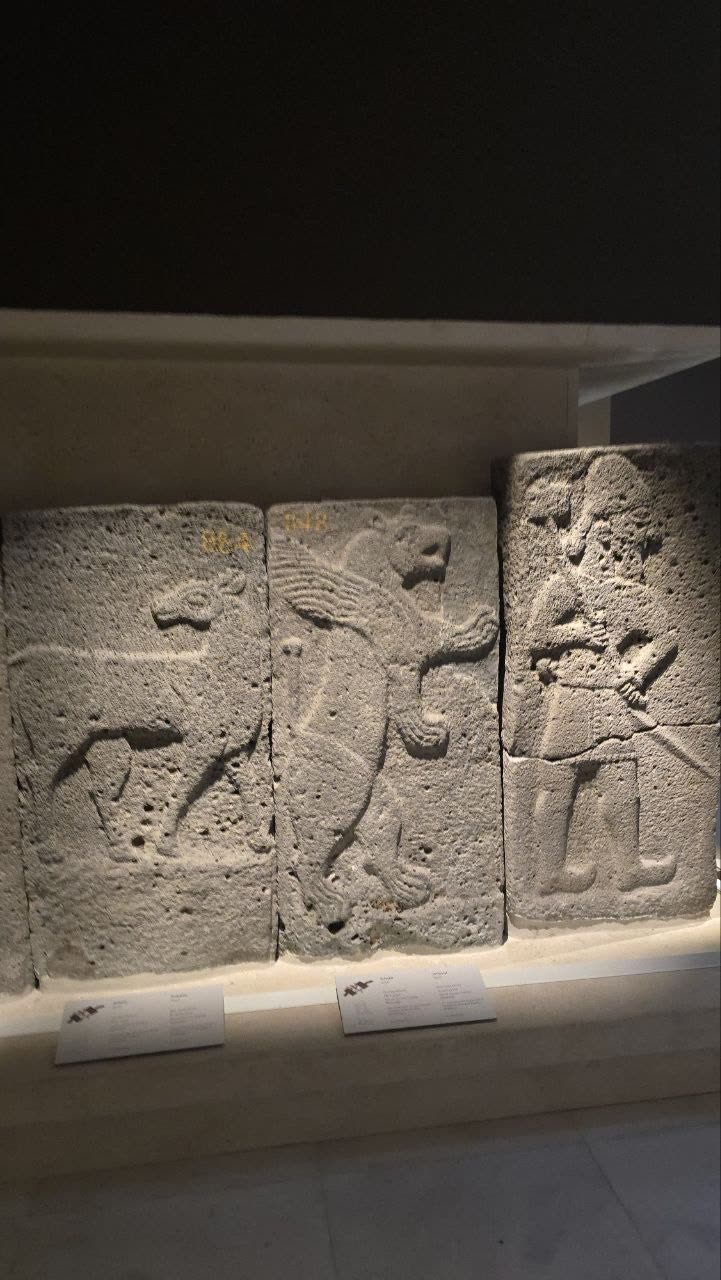
Doe, winged lion and warrior
A run of slabs in sequence: animal, guardian monster, man. This is how the frieze ran along the gate.
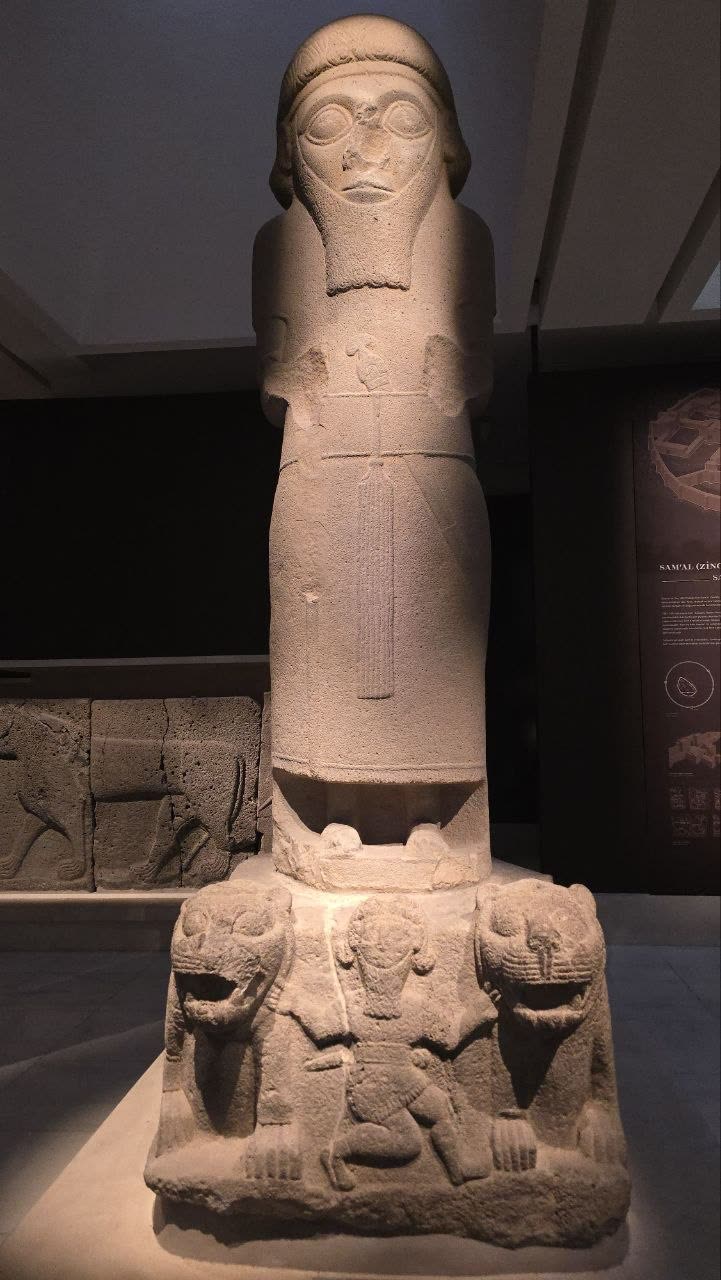
Statue of a king, probably Kilamuwa
The king stands on a base where a hero grips two lions. Kilamuwa is the best-known ruler of Sam'al. His inscription, in which he boasts that under him "a man who had never seen an ox became the owner of a herd", is in Berlin.
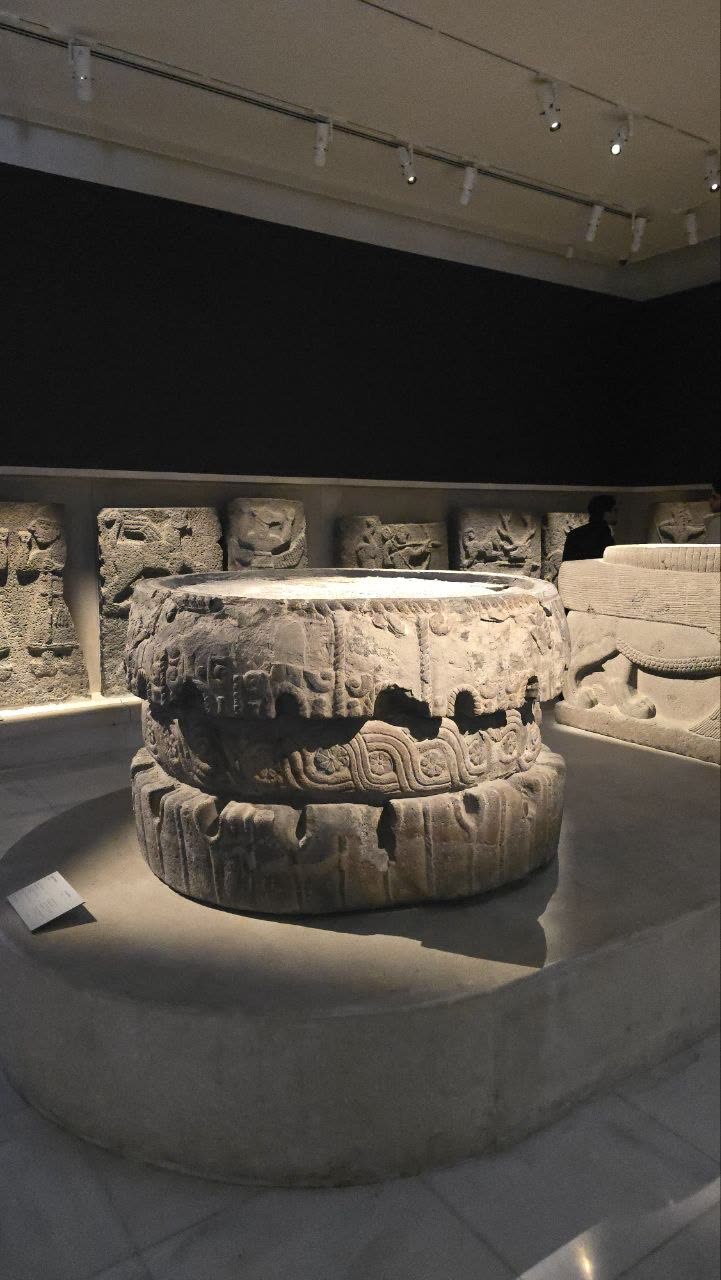
Column base from the palace of Bar-Rakib
Bar-Rakib was the last king of Sam'al and a vassal of the Assyrian king Tiglath-Pileser III. Soon afterwards Sam'al became an Assyrian province.
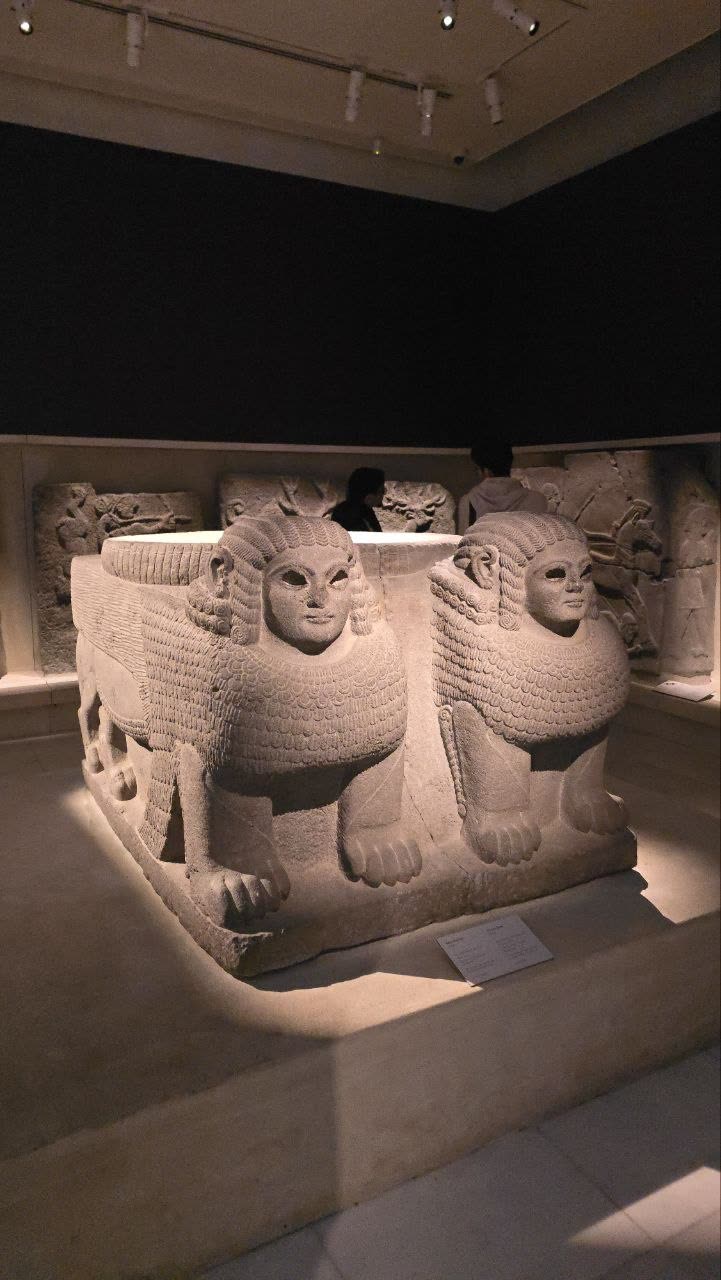
Column base with two sphinxes
The wooden column of the portico stood right on the sphinxes' backs. Anyone entering the palace met their faces at eye level.
7th–6th centuries BC · the Archaic period
The Phoenicians, Cyprus and the first centuries of Greek sculpture. Poses are still stiff, and faces wear the "Archaic smile".
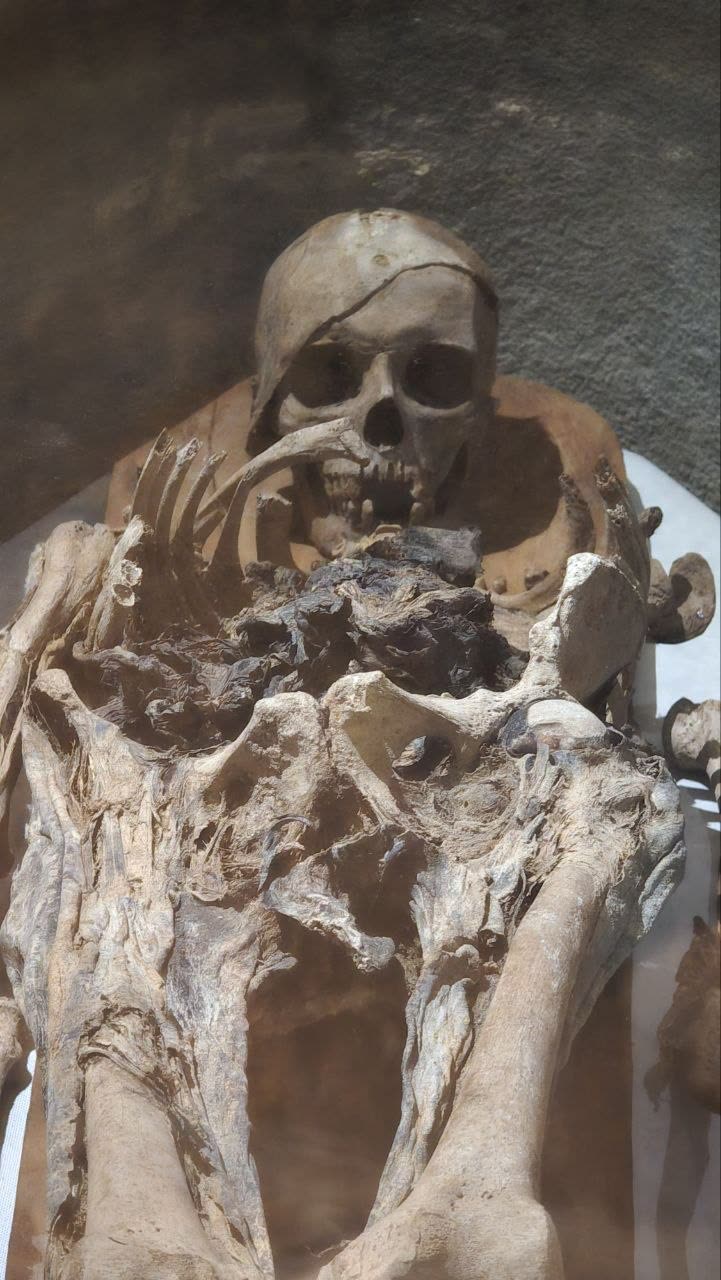
Mummy
You can see the skull, the bones and what is left of the linen wrappings and resin. This museum displays, next to the sarcophagus of Tabnit, the mummy of Tabnit himself, a 6th-century BC king of Sidon embalmed in the Egyptian manner. If this is it, it was found in 1887 in the royal necropolis of Sidon, together with the Alexander Sarcophagus.
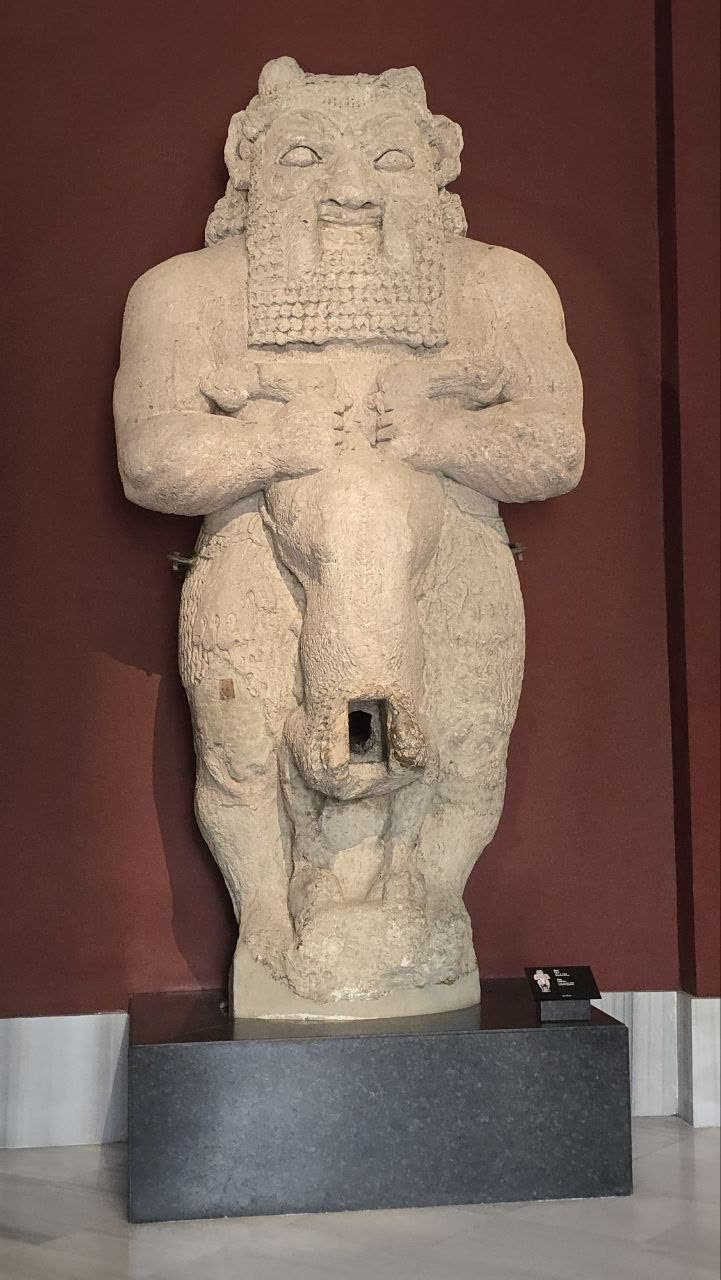
Bes from Amathus
Bes was a grimacing Egyptian dwarf god. He drove off evil spirits and protected childbirth and the home. The Phoenicians took up his cult, and Amathus was strongly under their influence. Bes holds a headless lioness. The opening where her neck should be was probably the spout of a fountain.
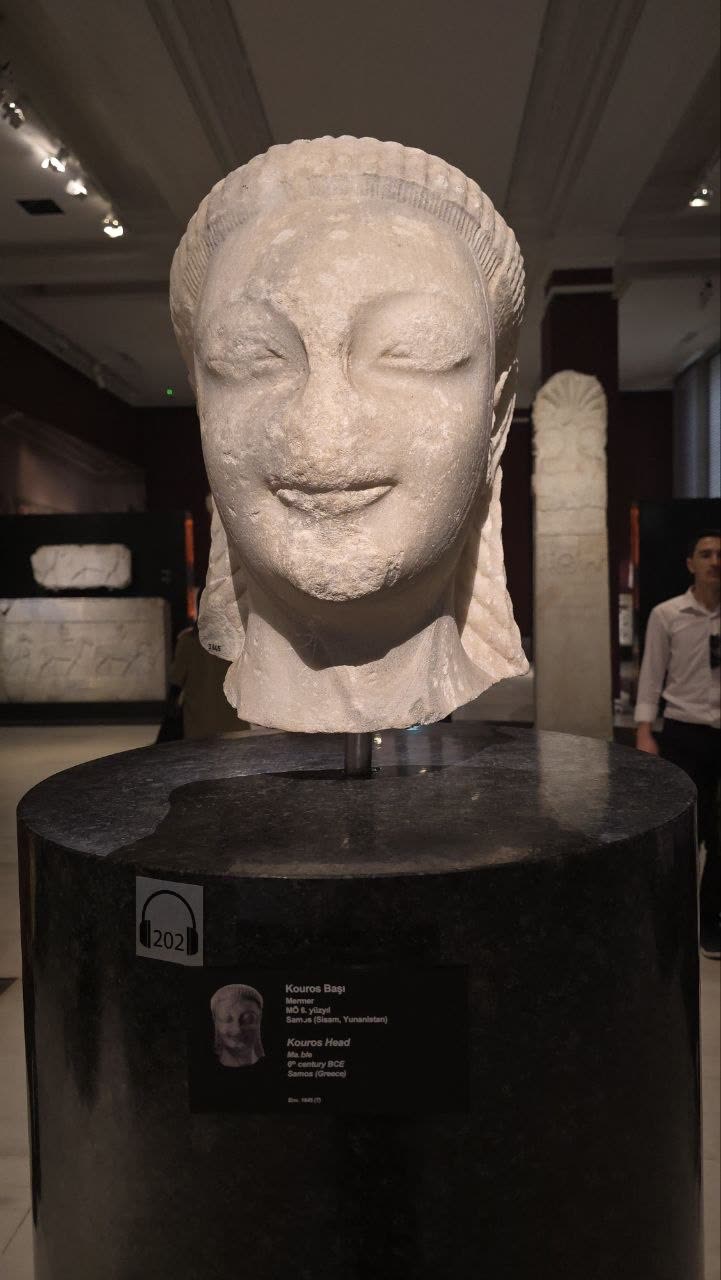
Head of a kouros
A kouros is a full-length statue of a naked youth with the left foot set slightly forward. Statues like this were set up in sanctuaries as gifts to a god, or on graves. The smile says nothing about his mood: it was how sculptors of the time showed that a figure was alive.
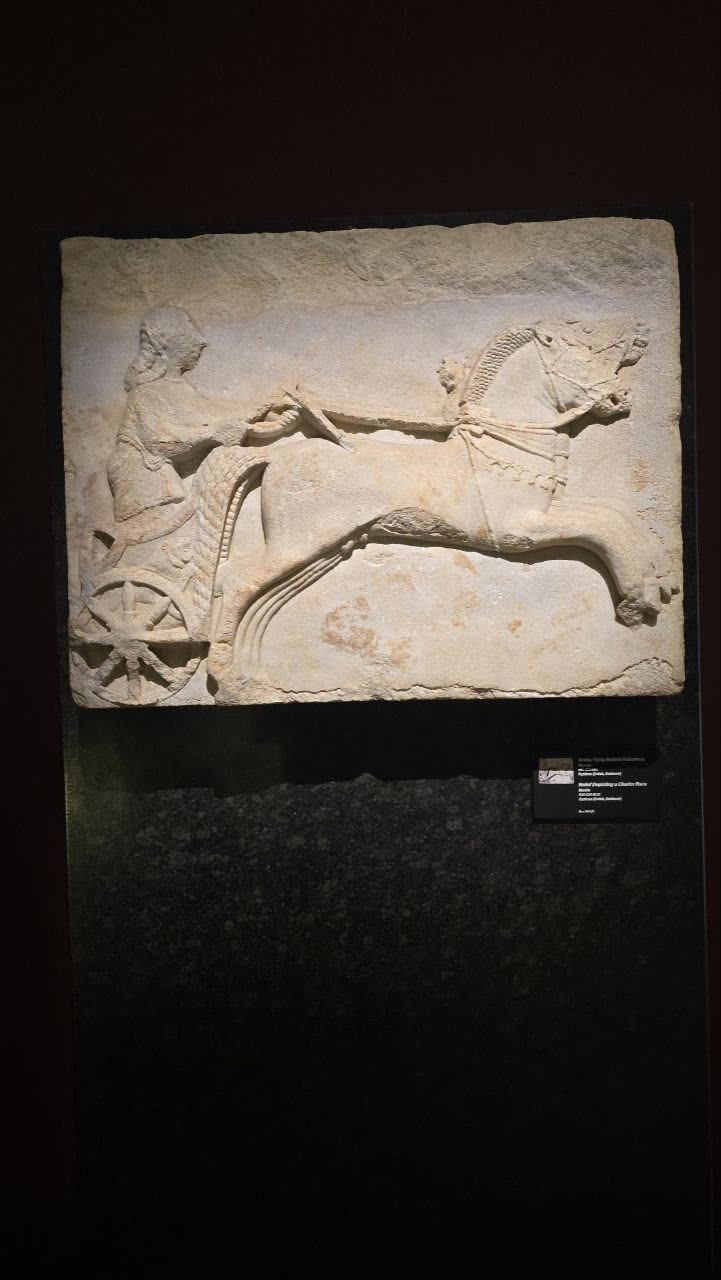
Chariot race
A charioteer in a long chiton drives his horses at a gallop. Cyzicus was a rich Greek colony on the Sea of Marmara. Chariot racing was the main event at the games and the most prestigious.
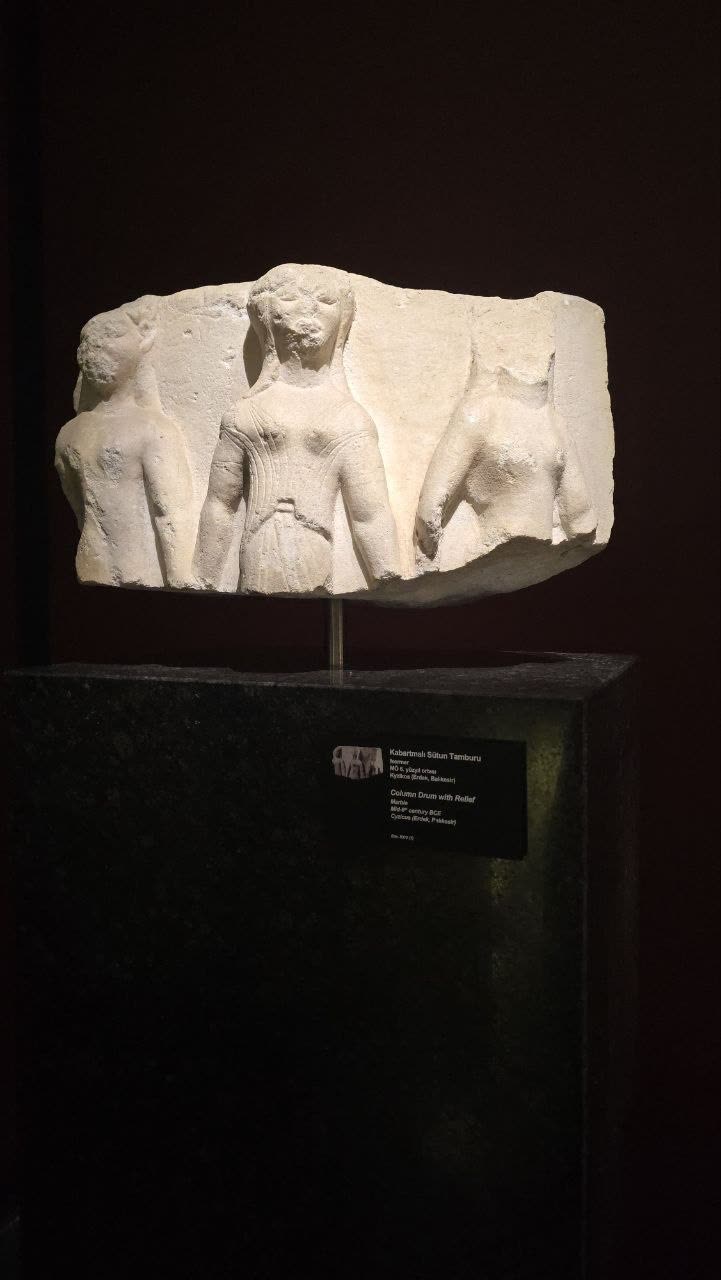
Column drum with relief
The lowest drum of a temple column, wrapped in figures. Only the richest Ionian temples had carved columns like this, Ephesus for one.
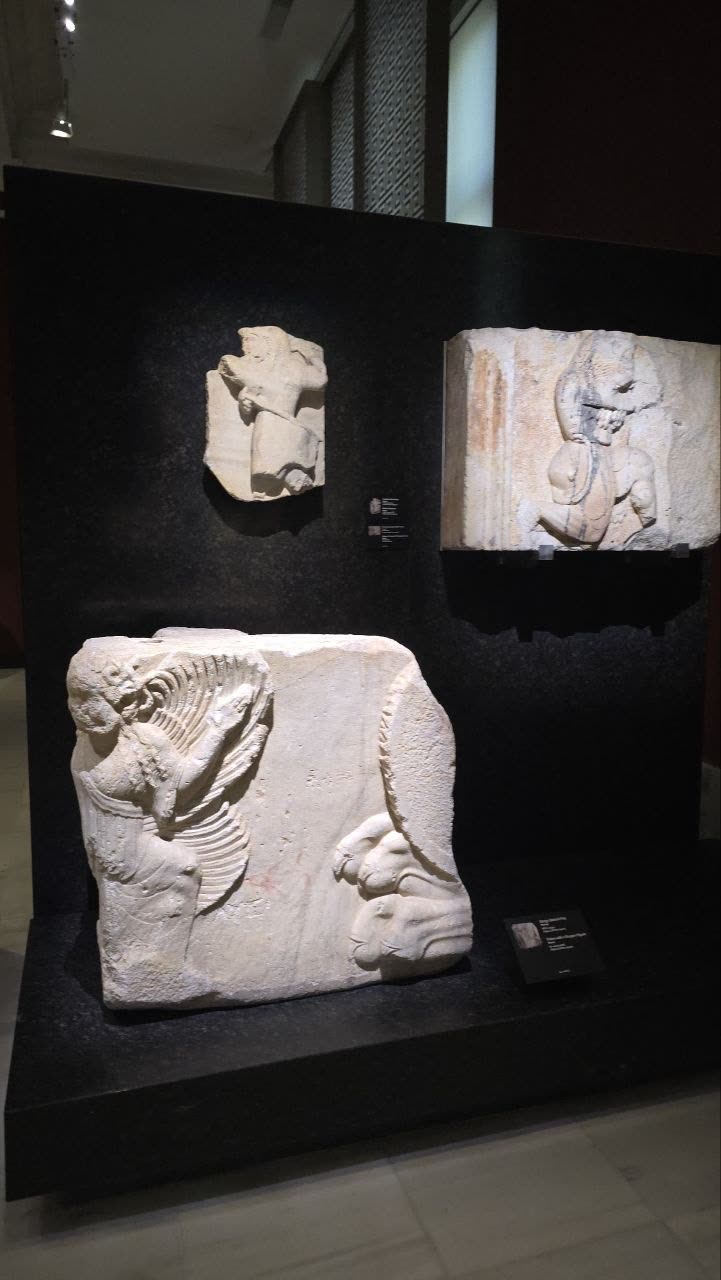
Reliefs with predators
A lion mauling its prey was a favourite subject on Archaic tombs and temples in Asia Minor, an image of strength and death. The label in the photo can't be read, so this is described from the image.
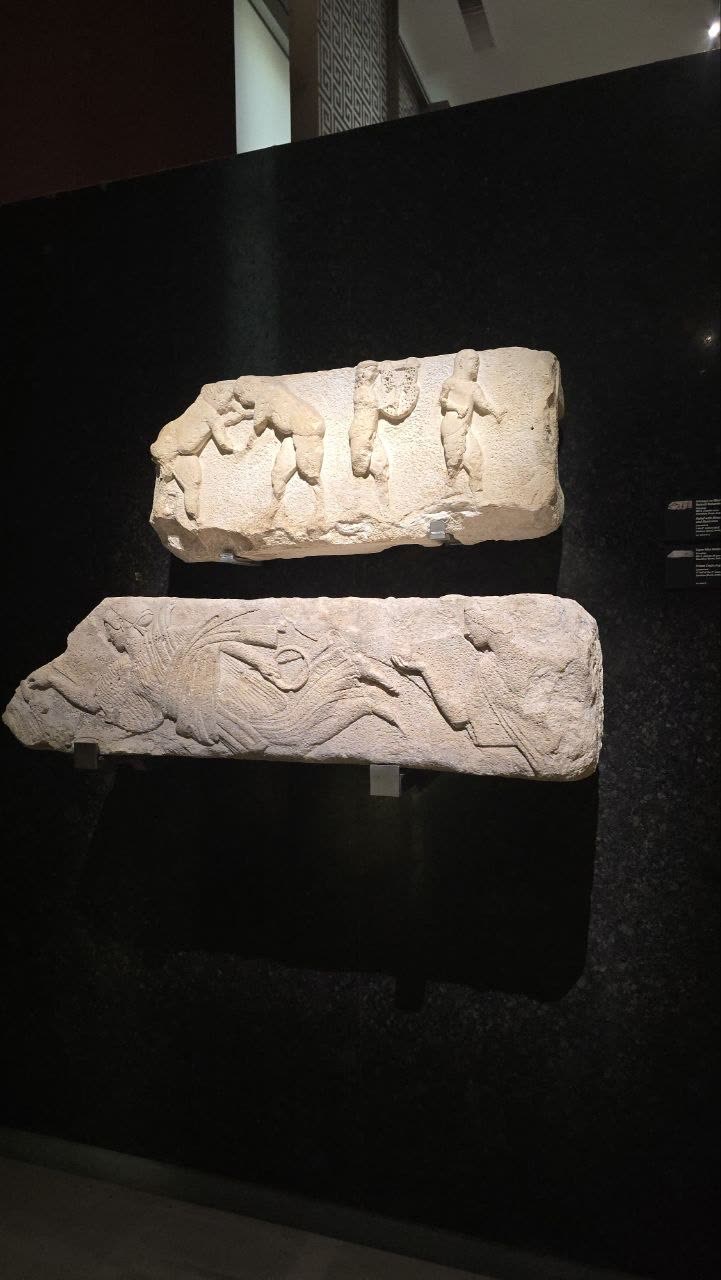
Wrestlers, musicians and a flying Nike
Xanthos was the capital of Lycia. The upper frieze shows wrestlers and musicians, that is, funeral games held for the dead man. The lower one shows Nike, goddess of victory, in flight. Both friezes come from Lycian tombs.
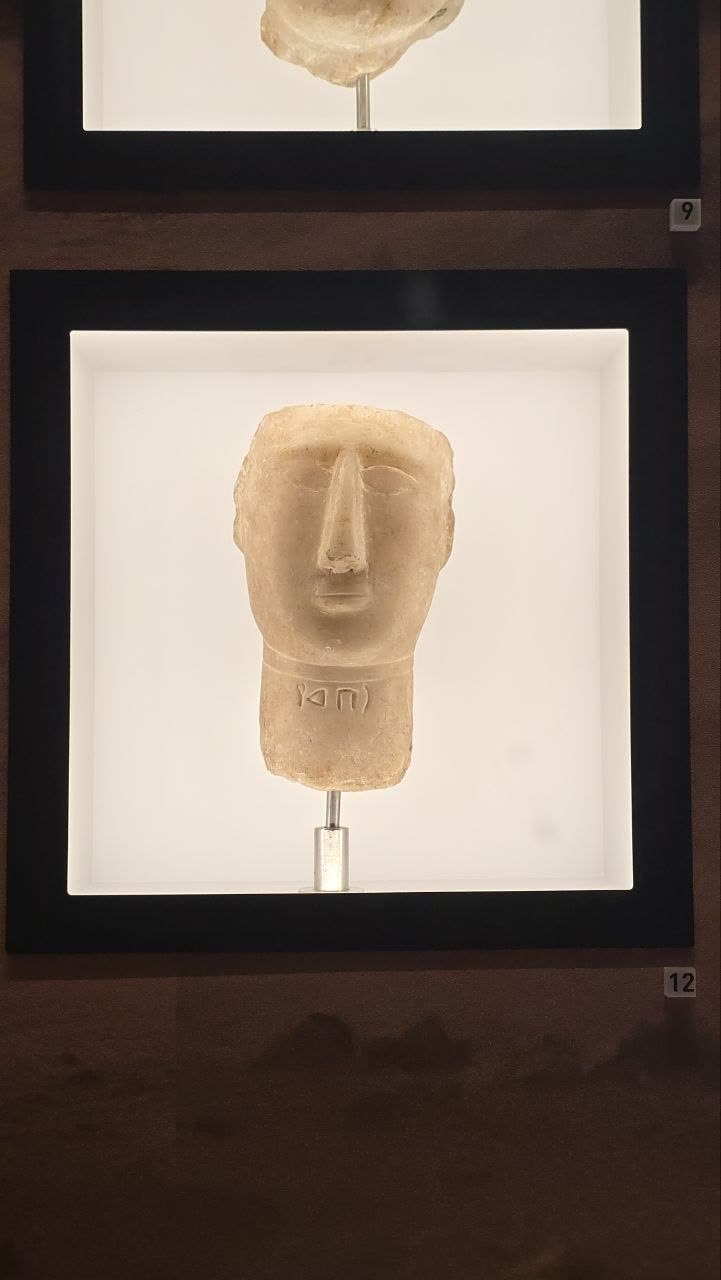
Funerary head from South Arabia
Heads like this were placed in tombs to stand in for a portrait of the dead. His name is written on the neck in the South Arabian musnad script. The eyes were once inlaid.
5th–4th centuries BC · the Classical period
Greek sculpture learned to show a living body in motion: weight on one leg, drapery that lets the figure show through.
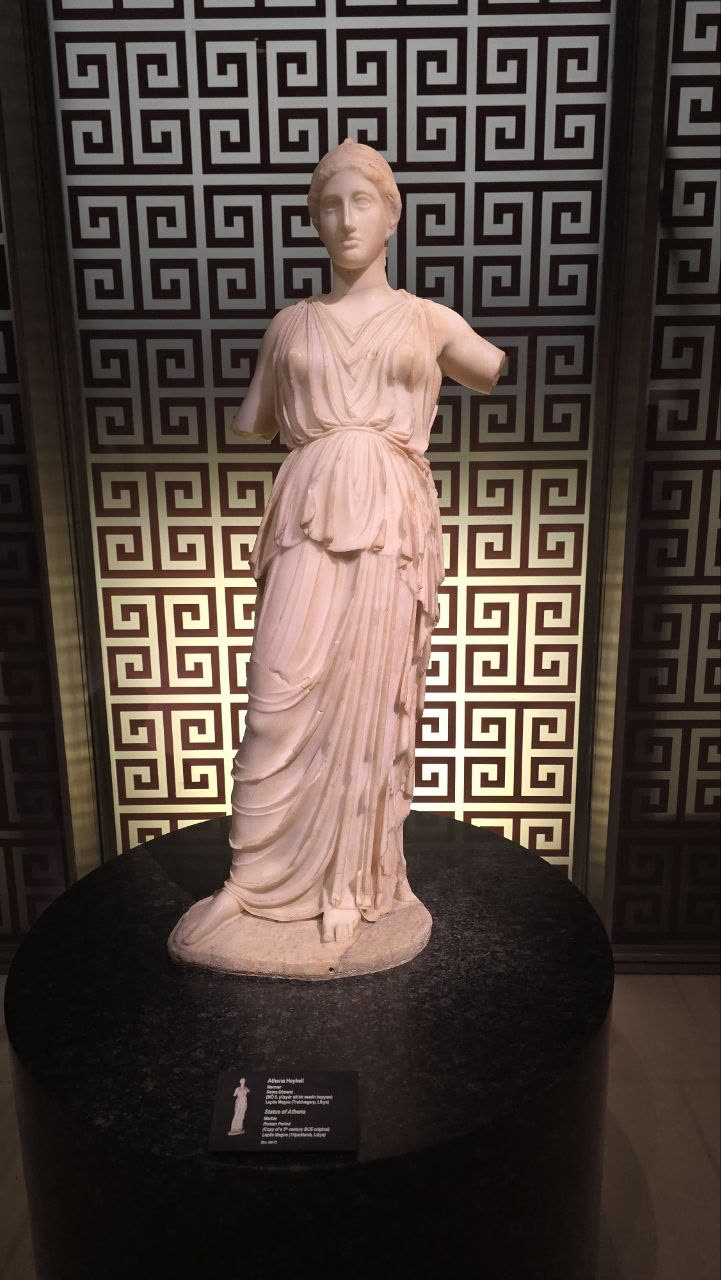
Athena from Leptis Magna
Almost all Greek bronze statues were melted down, and we know them from Roman marble copies like this one. Compare her with the kouros: about a hundred years later the stiff figure has given way to a relaxed stance with the weight on one leg, and the folds of the peplos show the body beneath. Leptis Magna was one of the richest Roman cities in Africa and the birthplace of the emperor Septimius Severus.
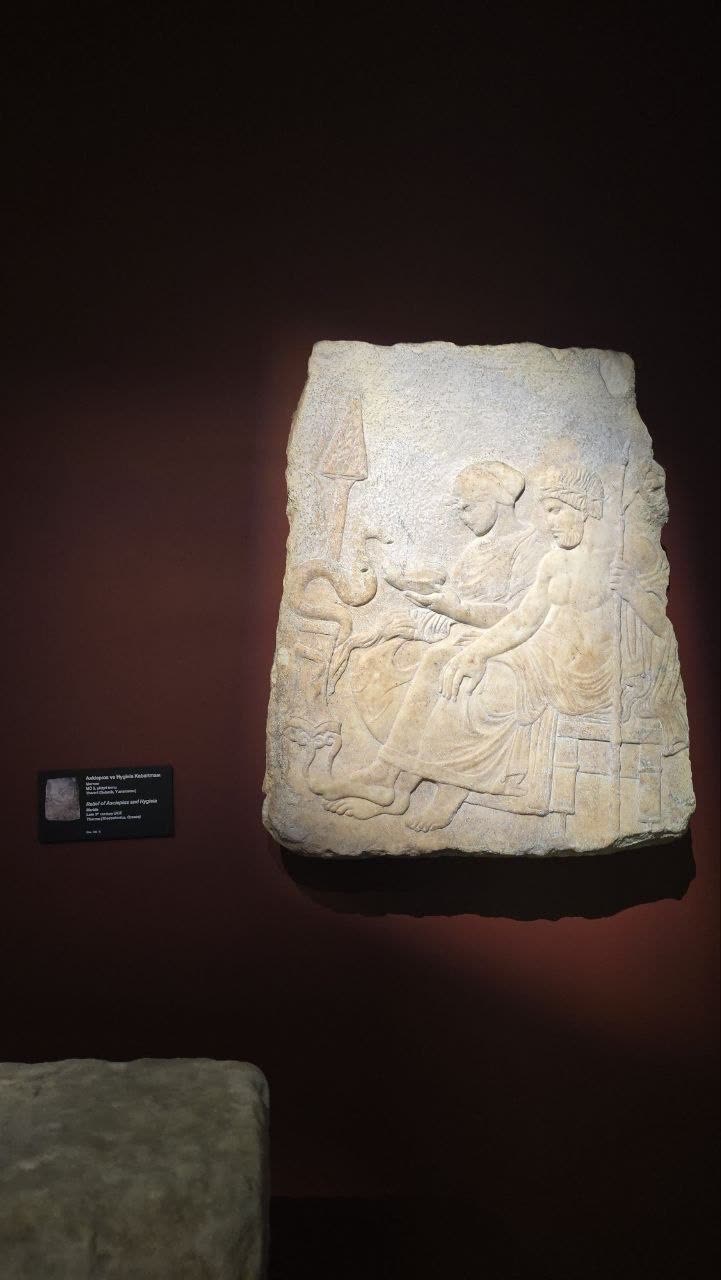
Asclepius and Hygieia
The god of healing sits beside his daughter Hygieia (her name gives us "hygiene"), with his sacred snake at his feet. Reliefs like this were given to a sanctuary of Asclepius after a recovery.
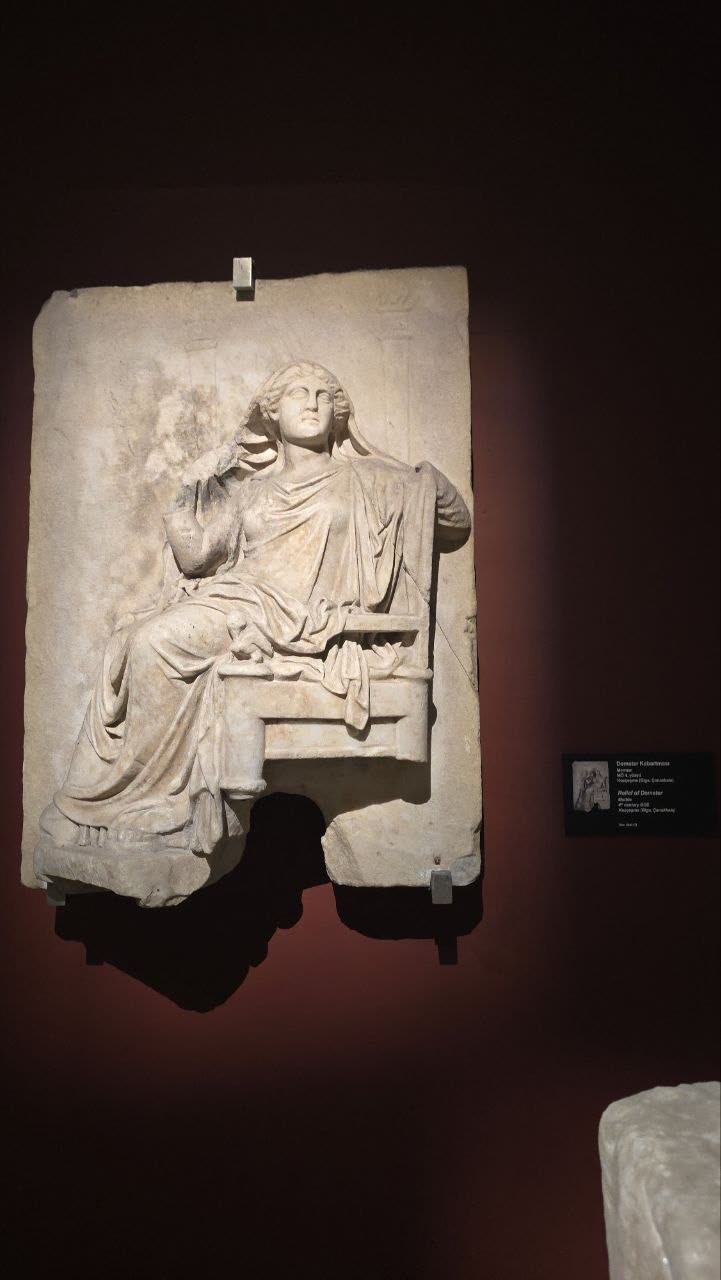
Demeter
The goddess of fertility and farming sits on a throne and lifts the edge of her veil, the gesture of a married woman. The soft folds of her clothes are typical of the 4th century.
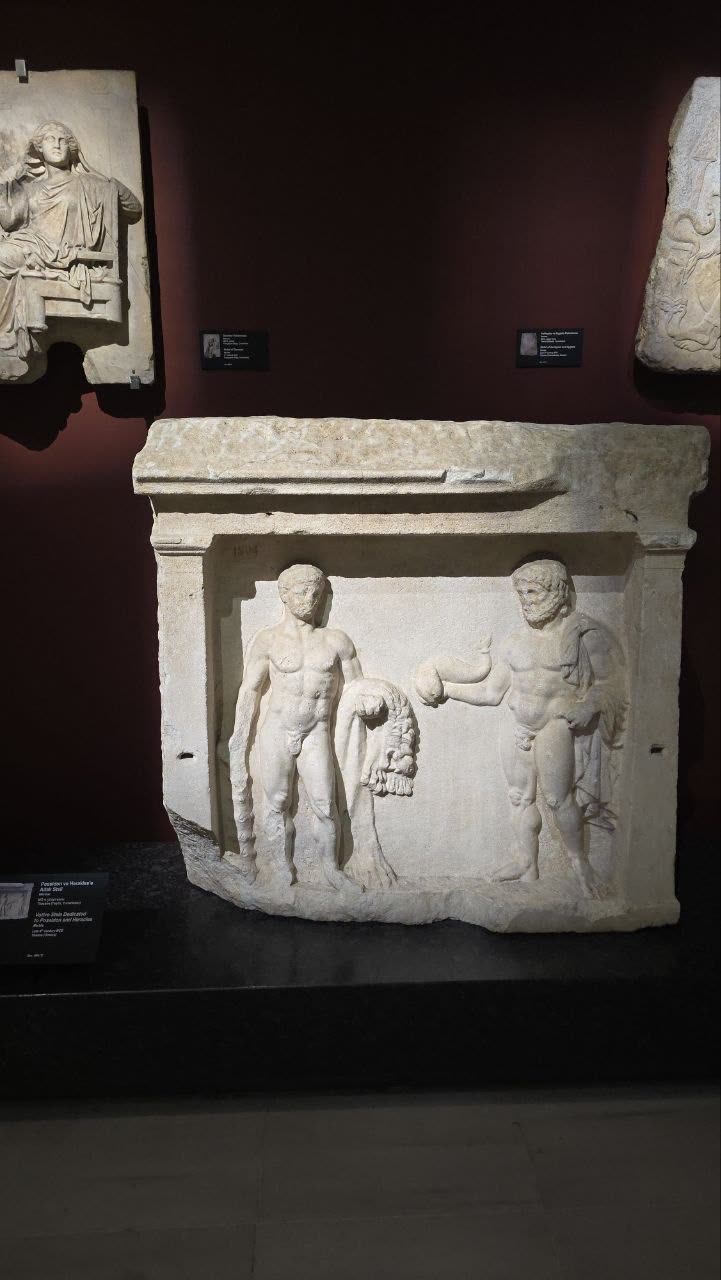
Stele dedicated to Poseidon and Herakles
A votive relief set in a naiskos frame, like a miniature temple. On the right is a bearded Poseidon, on the left Herakles with his lion skin. The bodies are now carved with complete ease and anatomical accuracy.
4th–1st centuries BC · the Hellenistic period
After the campaigns of Alexander the Great, Greek culture spread from Egypt to India. Sculptors turned to sensuality, unusual subjects and complex poses.
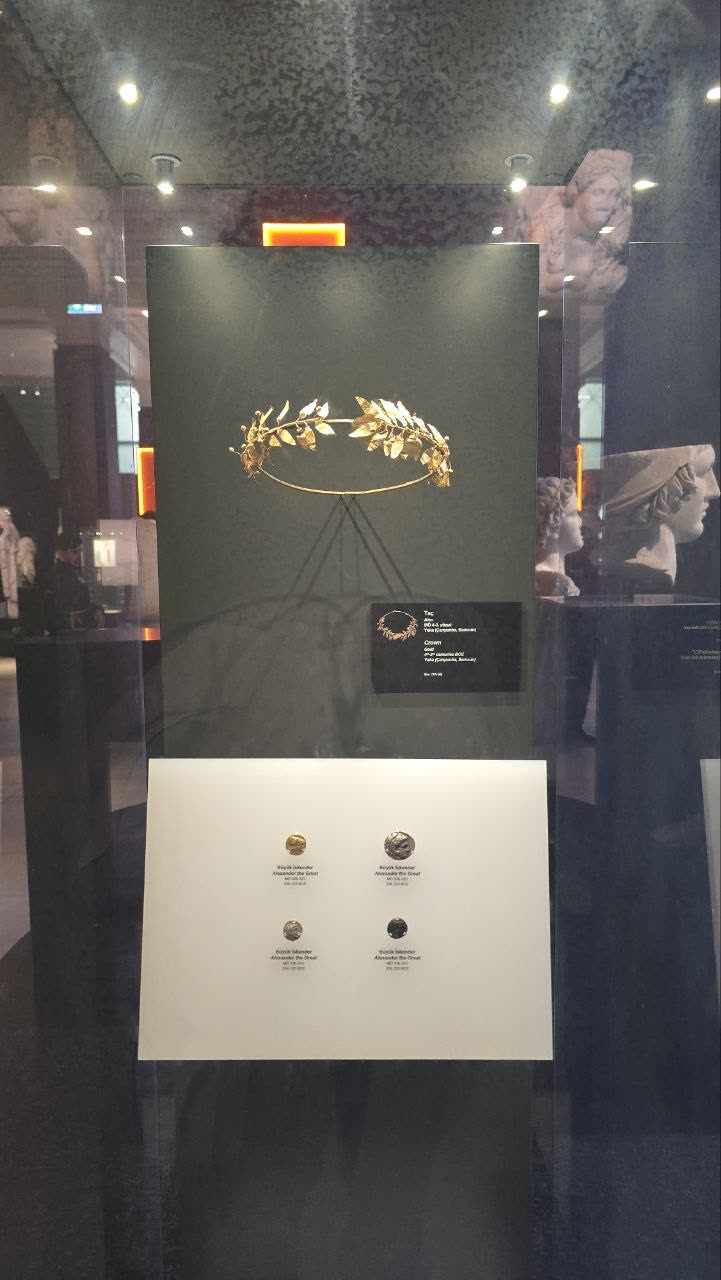
Gold wreath and coins of Alexander
A wreath of gold leaves was laid in the grave of a person of rank; in life, wreaths like this were worn at banquets and festivals. Below are coins of Alexander the Great. The silver ones show Herakles in his lion skin, the king's mythical ancestor; over time he came to be drawn with Alexander's own features.
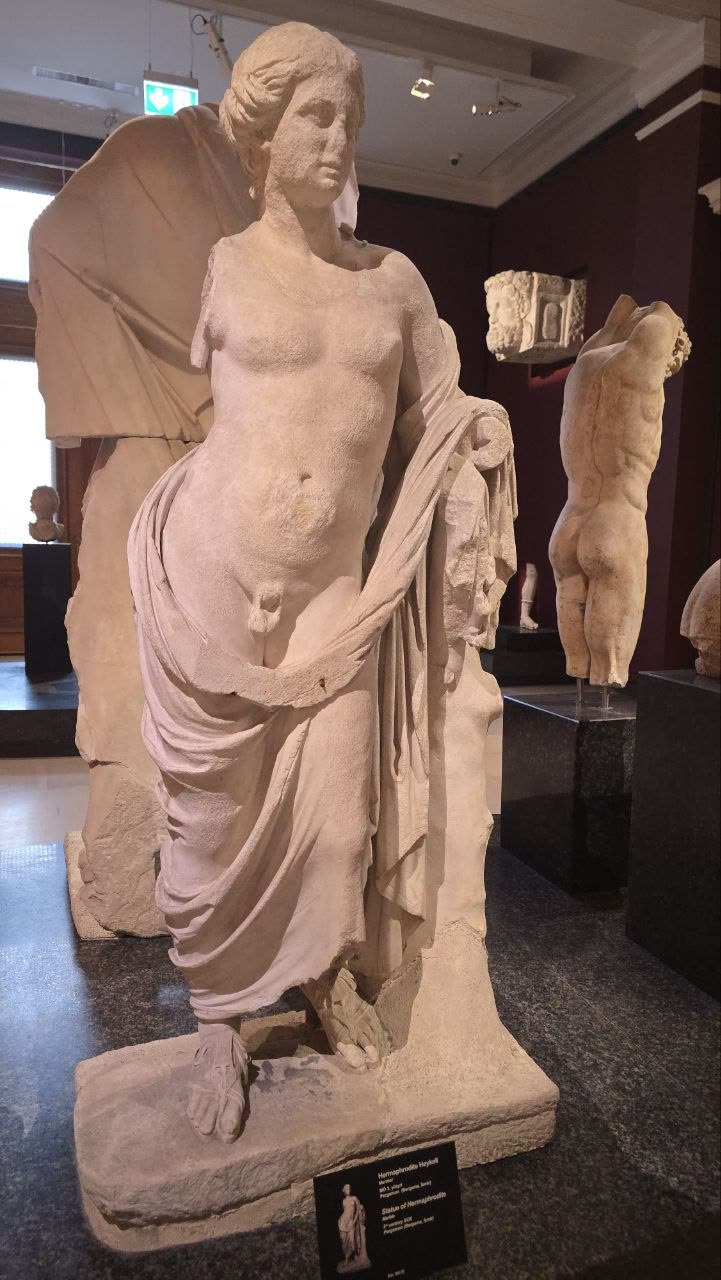
Hermaphroditus from Pergamon
Hermaphroditus was the son of Hermes and Aphrodite, merged with the nymph Salmacis into a single being. The sculptor plays with your expectations on purpose: from above the figure is female, and the lifted drapery reveals that it is male. Under the Attalid kings, Pergamon was one of the main centres of Hellenistic art.
1st century BC–4th century AD · the Roman Empire
Asia Minor was one of Rome's richest provinces. Greek craftsmen worked for Roman patrons, and the portrait became the leading genre.
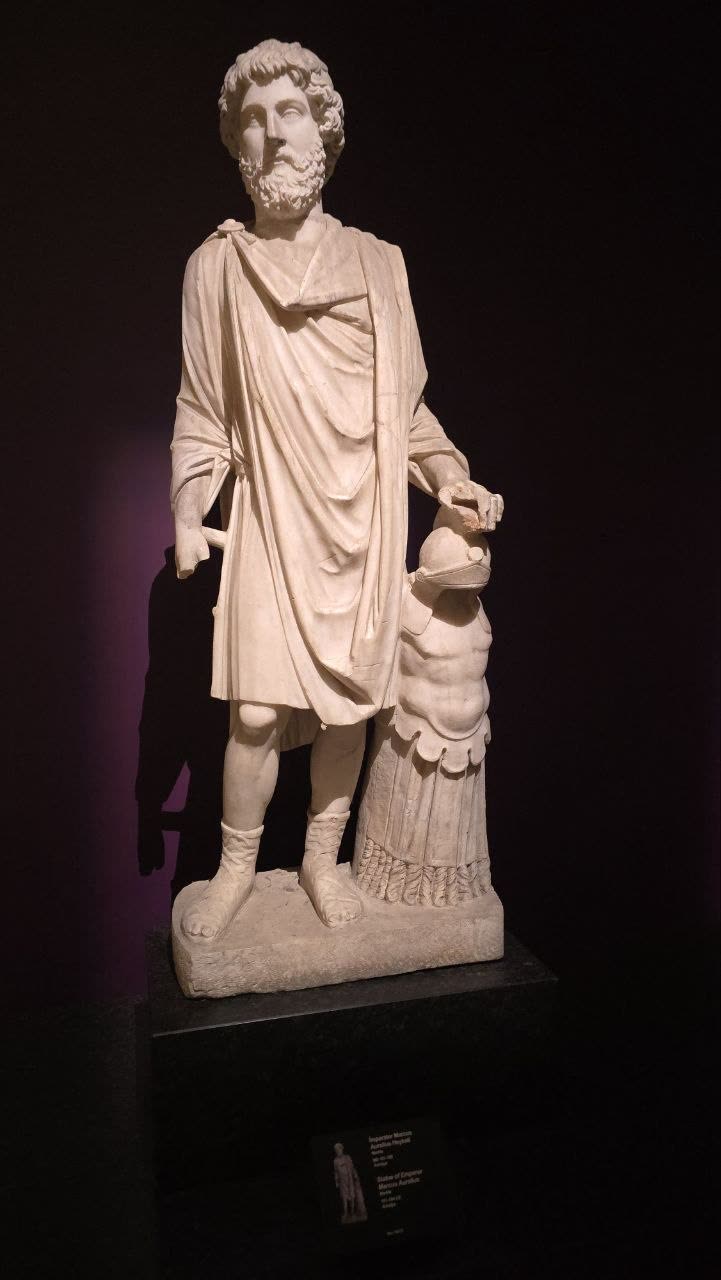
Emperor Marcus Aurelius
The philosopher-emperor who wrote the Meditations. He was portrayed with a full curly beard, like a Greek thinker, a fashion his predecessor Hadrian had started. Next to him are a cuirass and helmet: he spent half his life at war on the Danube. The cloak in place of armour presents the ruler in peaceful, civilian guise.
Wall of Roman portraits
Emperors, their families and private individuals. Hair and beards make these portraits easy to date: under Augustus men were clean-shaven with a short fringe, and from the 2nd century, starting with Hadrian, they wore beards. Women's hairstyles copied those of the empresses.
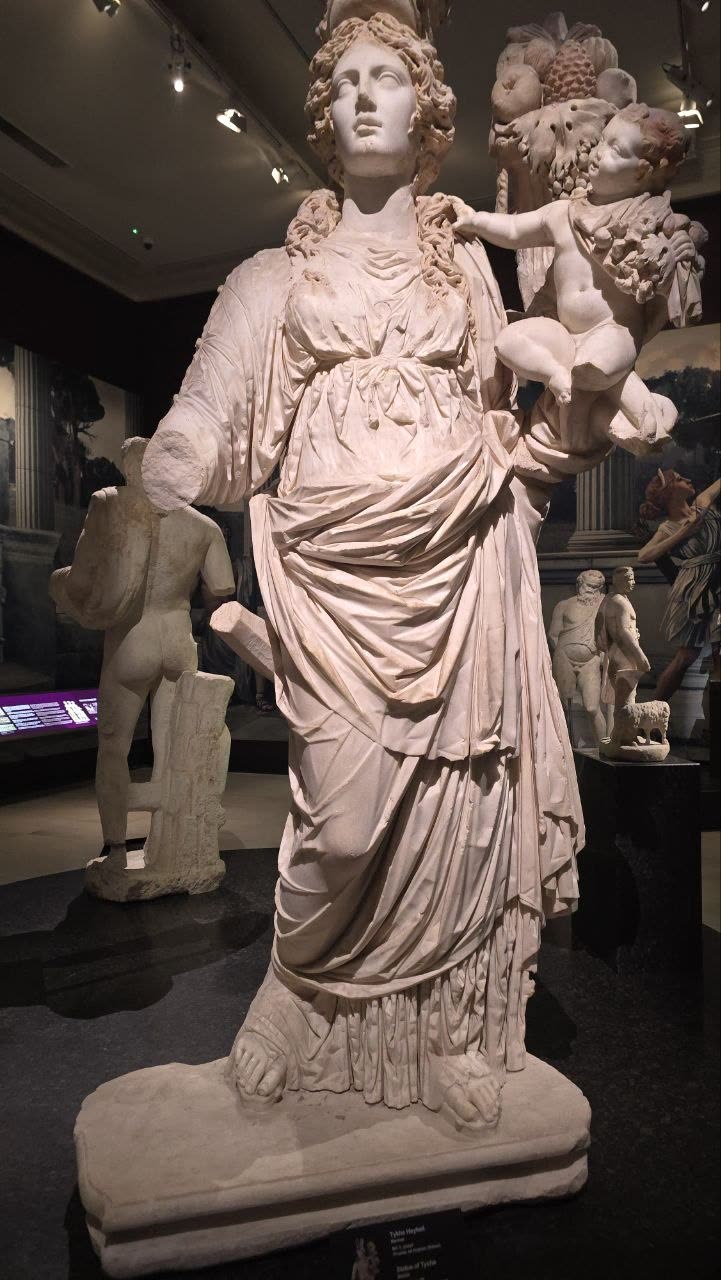
Tyche with the infant Plutus
The goddess of fortune and protector of the city; statues like this usually wore a crown shaped like a city wall. She holds a cornucopia with little Plutus, god of wealth, sitting on it: good fortune brings the city prosperity.
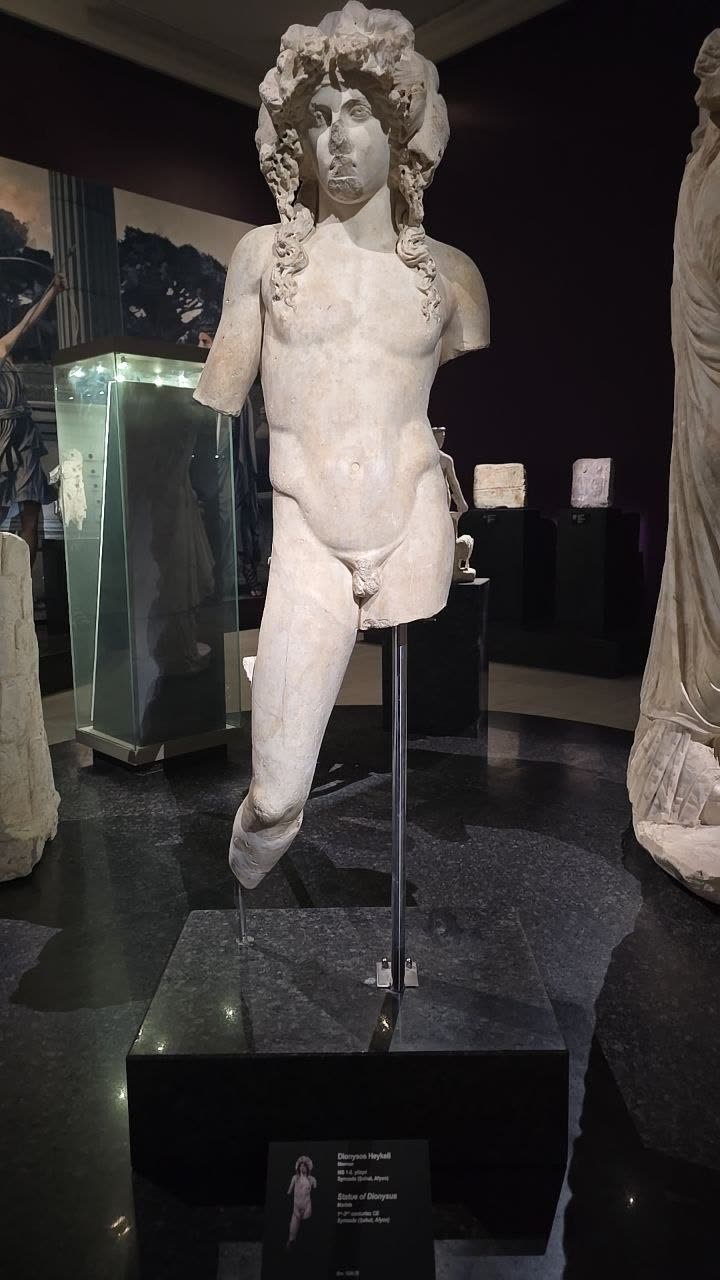
Dionysus
The god of wine and theatre, young, with long locks and a wreath of ivy and bunches of grapes. The soft, almost feminine body is his standard image, the opposite of the muscular Herakles. Synnada was famous for its quarries of multicoloured marble, which was shipped all over the empire.
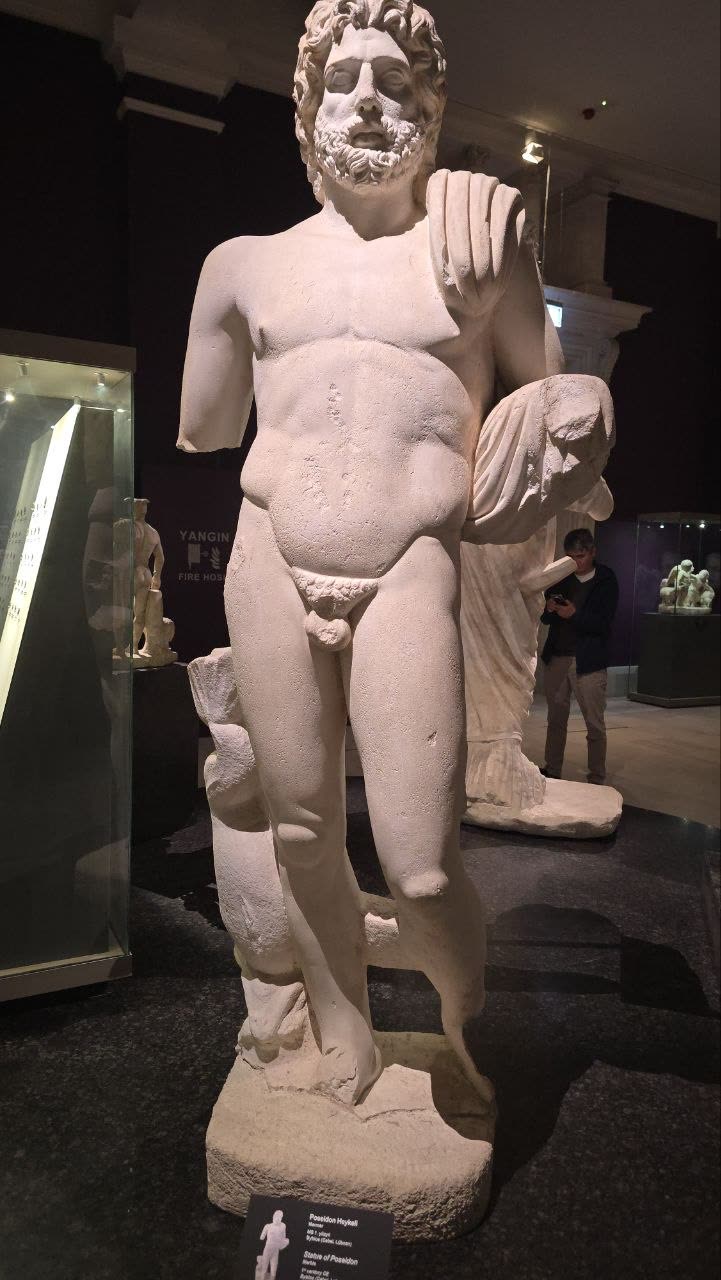
Poseidon from Byblos
The sea god with a thick beard and a cloak over his shoulder. Beside his leg there was probably a dolphin, his usual companion. Byblos is one of the oldest cities in the world, a Phoenician port that gave the Greeks their word for book, biblos, because Egyptian papyrus passed through it.
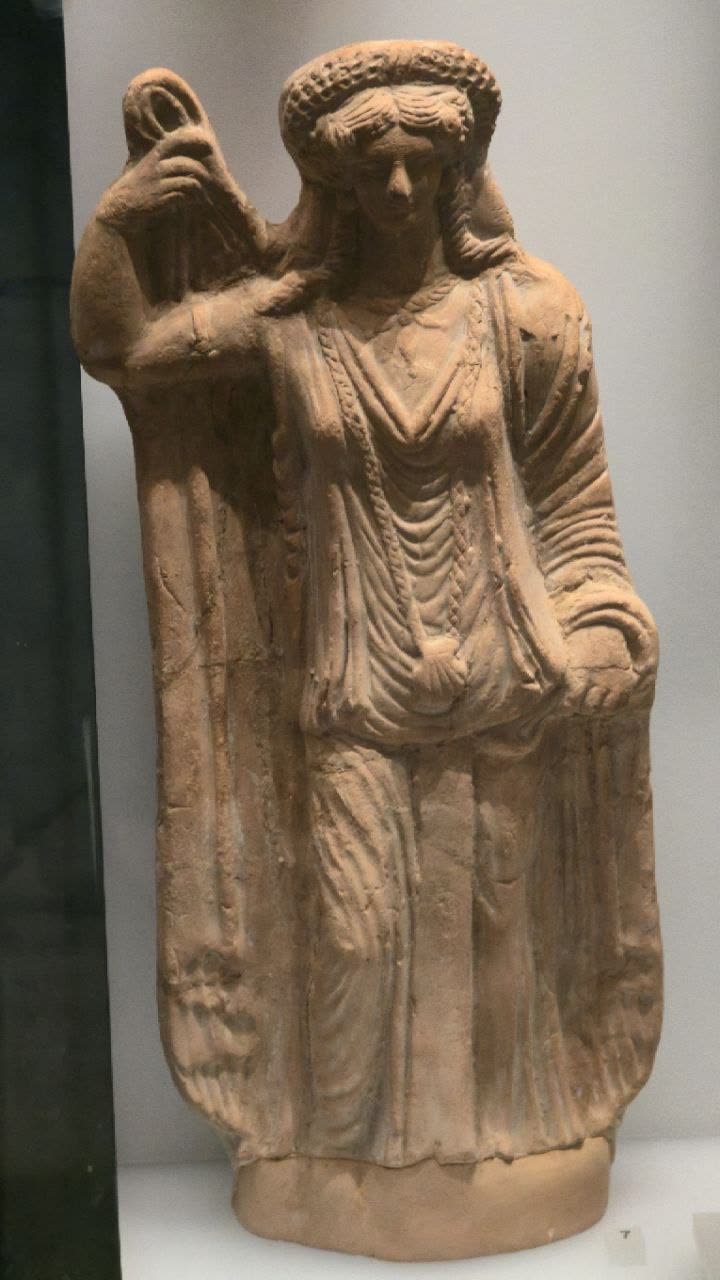
Isis with a sistrum
An Egyptian goddess whose cult spread across the whole empire. You can tell her by the knot on her breast (the "Isis knot") and the sistrum in her raised hand, a metal rattle used in temple rites. The label isn't visible in the photo, so this is described from the image.
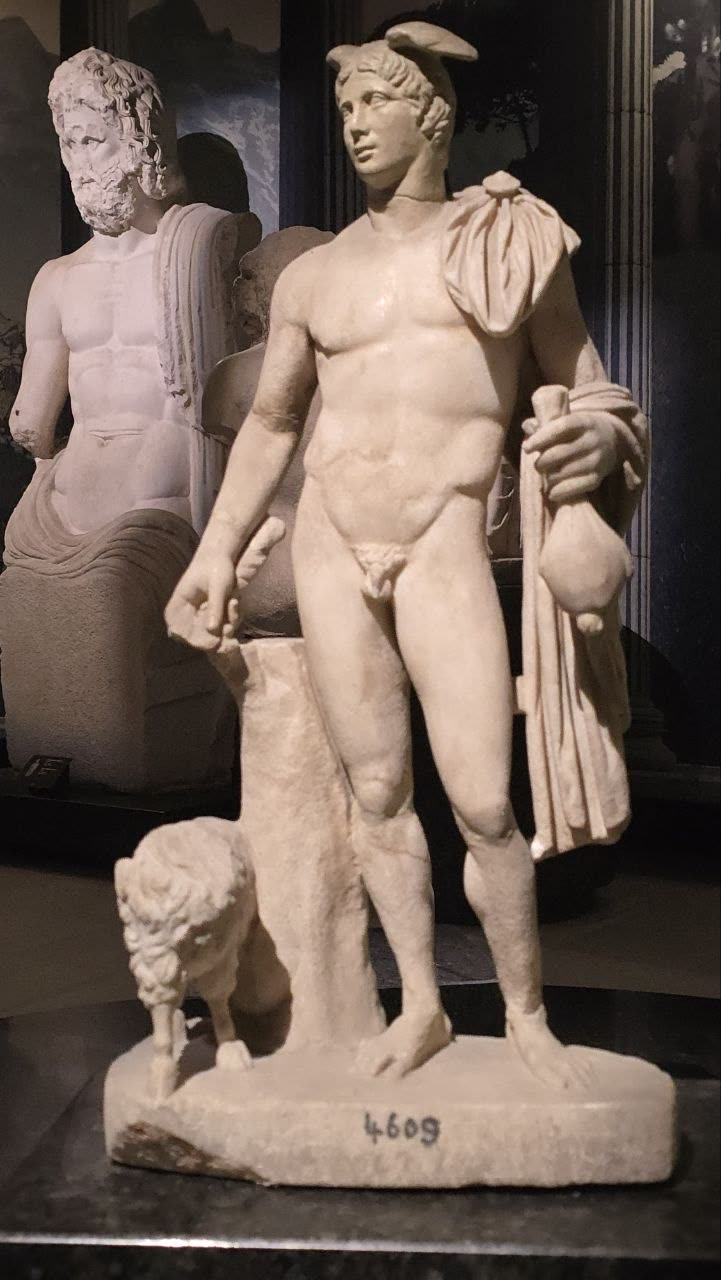
Hermes with a purse and a ram
The god of trade and travellers, and messenger of the gods. He has little wings on his head, a chlamys cloak, and a purse of money in his hand, since he protected merchants. The ram at his feet is a reminder that he also looked after flocks. The label isn't visible in the photo.
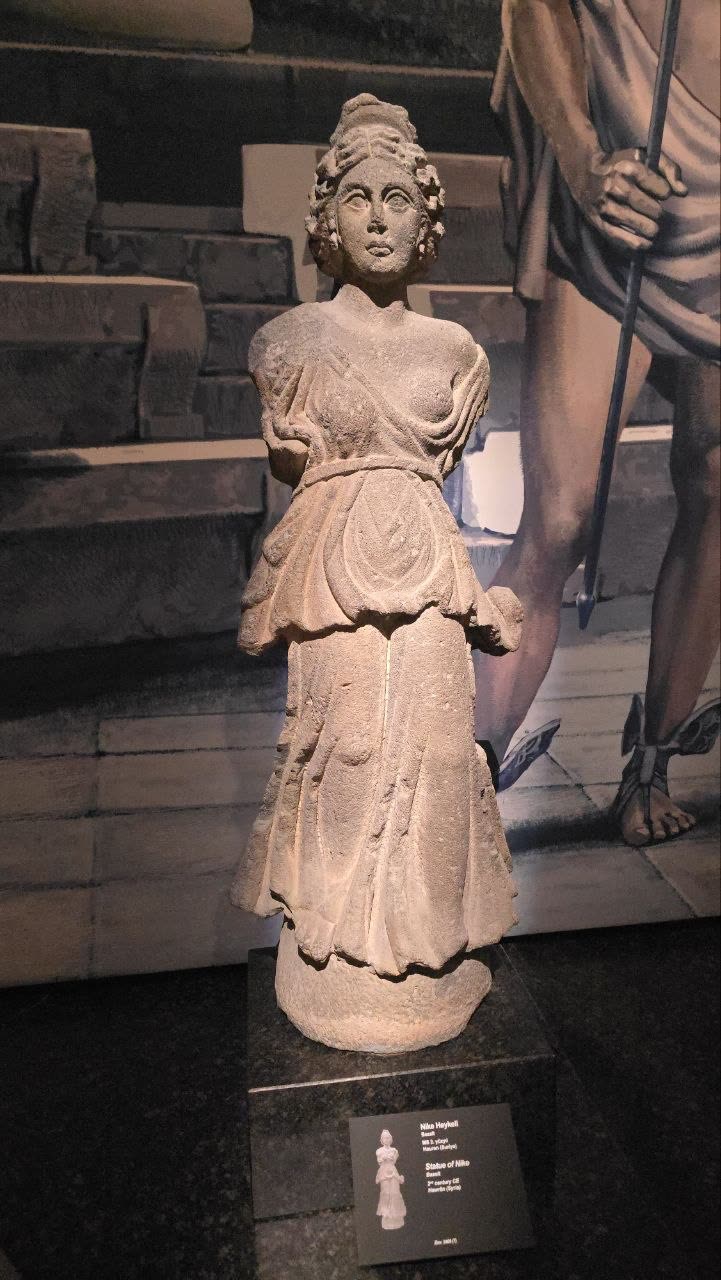
Nike from the Hauran
The goddess of victory, carved here in black volcanic basalt, since the Hauran has no other stone. A Graeco-Roman image in the hands of a local sculptor: the face and hair are simpler, the folds harder.
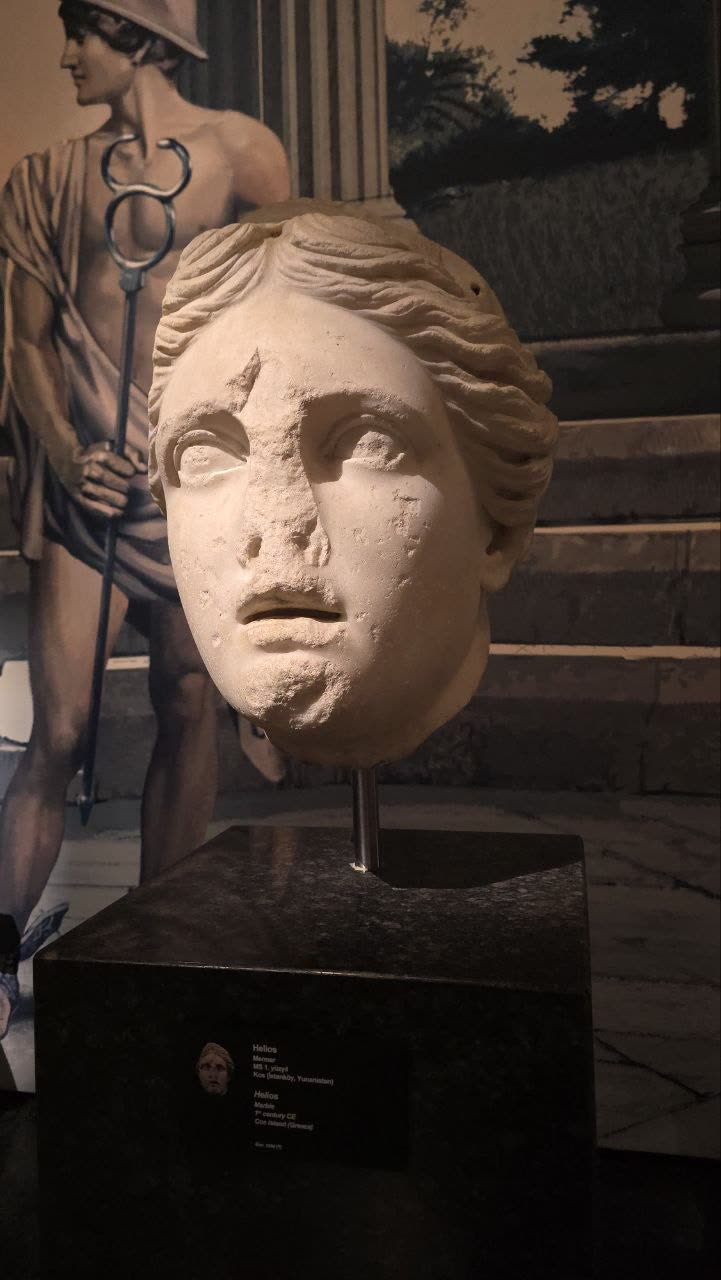
Head of Helios
The sun god gazes upward with his mouth half open, a style full of pathos inherited from Hellenistic sculpture. The holes in the head held the metal rays of his crown.
Attributions and dates come from the museum labels. The explanations draw on general sources; where a label in the photo can't be read, the description is based on the image itself.